
Chairside 11
Lack of Posterior Occlusion — a Hidden Obstacle to a Maxillary Overdenture
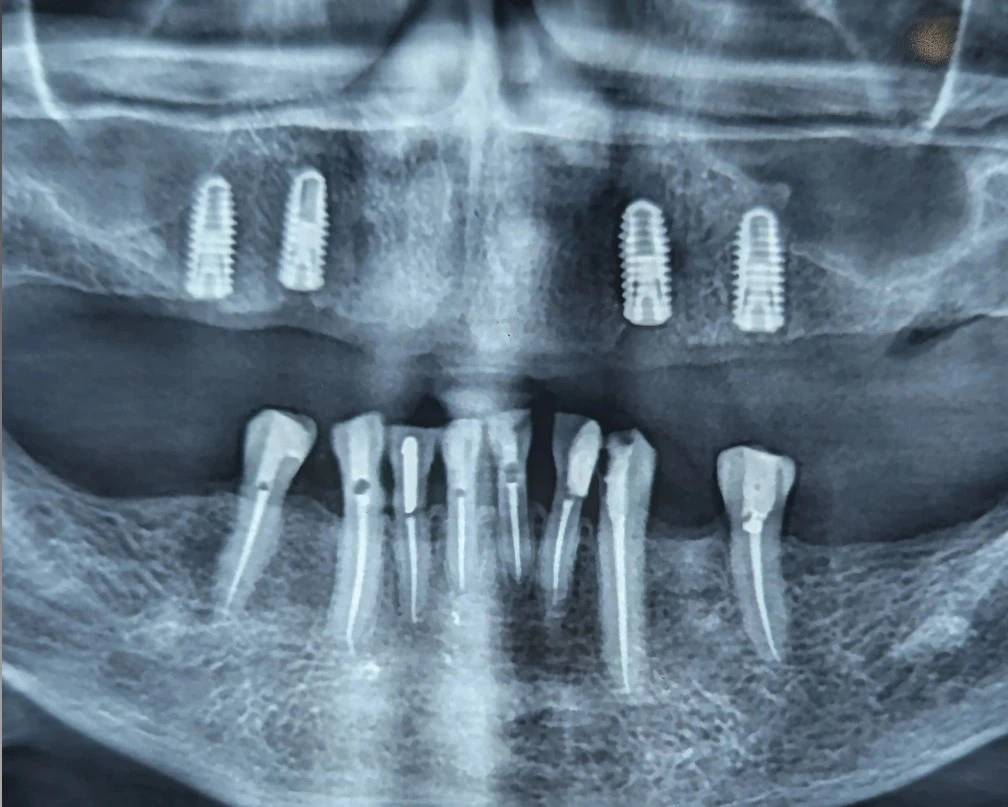
-
The patient had presented for the purpose of a maxillary overdenture.
The maxillary implants had previously been placed at another center, and the initial treatment plan had not been provided by me.
-
At first glance, the number of implants seemed acceptable for an overdenture;
but two important considerations meant that entering the prosthetic phase was not accepted.
-
The first consideration was the uncertainty about the quality of the surgery and where the treatment was performed.
The implants had been placed at a center about which there was insufficient confidence regarding how the treatment was carried out and by whom.
In such conditions, entering the prosthetic phase without certainty about the foundation of the treatment can create a risk of unpredictability.
-
But the main consideration was the patient's occlusal status.
In the lower jaw there was no effective posterior occlusion, and the contacts were concentrated mainly in the anterior region.
-
In fixed restorations, the importance of posterior occlusion is well recognized;
but in removable prostheses such as an overdenture, this matter is even more critical.
-
In the absence of posterior support, the functional forces are transferred mainly to the anterior region.
In a maxillary overdenture, this situation can cause an increase in unfavorable forces.
-
Ultimately, these conditions may lead to repeated loosening of the attachments, detachment of the acrylic teeth, and repeated prosthesis failures.
-
Therefore, before any treatment in the upper jaw, it was necessary to establish posterior support in the lower jaw.
-
This goal could be pursued through two paths:
• Placing implants in the posterior regions of the lower jaw
• Or designing a partial denture to reconstruct the posterior occlusion
-
If a partial denture were chosen, the abutment teeth would first have to be evaluated;
and in some regions there was a possibility of needing a bridge to close the spaces and create an adequate abutment.
Then the partial denture would be designed and posterior support established.
-
The patient was seeking treatment only for the upper jaw and had no desire to correct the conditions of the lower jaw.
Given that performing an overdenture without posterior support would not produce a predictable result, entering the prosthetic phase was not accepted.
-
This case is a reminder:
A successful overdenture does not depend only on the number of implants;
sometimes what determines the outcome of treatment is not in the jaw being treated,
but in the occlusion of the jaw it is meant to work against.
The content of this page is intended for the educational use of dentists and dental students.