
Chairside 12
Discrepancy Between the Finish Line and the Crown Margin — an Error Seen Late
-
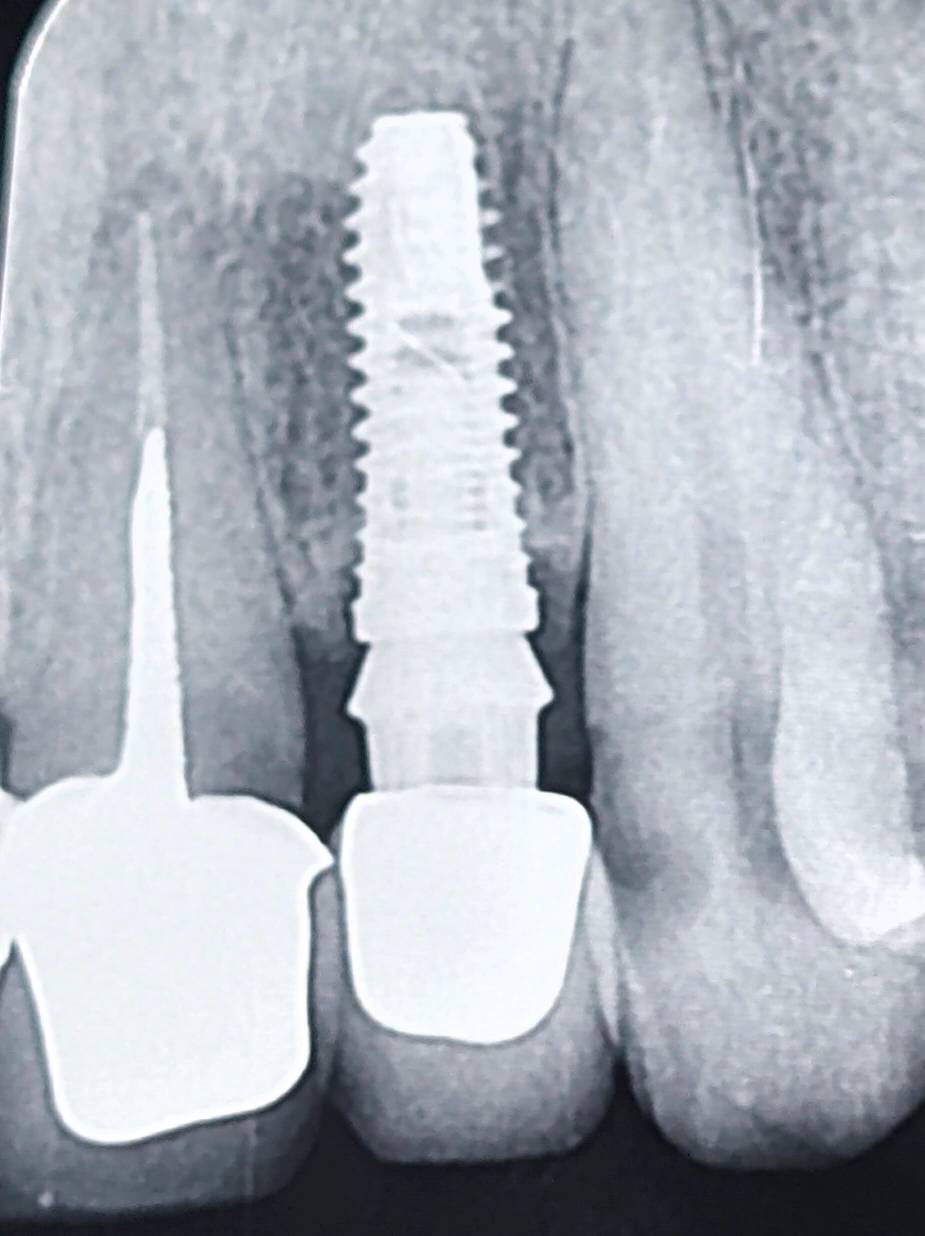
The patient had presented with an anterior implant crown.
-
On radiographic examination, a significant discrepancy between the abutment finish line and the crown margin was seen.
In other words, the crown margin was positioned below the finish line, and a vertical gap had been created.
-
This type of error can usually arise at two stages:
• At the impression stage
• Or in the crown delivery phase
-
If the error occurs at the delivery session (for example, if the crown has not seated correctly),
the dentist can establish the occlusion by removing the interferences and adjusting the incisal or occlusal surface.
-
But in this case, the evidence showed that the crown had been fabricated in this very form from the start.
Neither in the framework nor in the porcelain was there any sign of binding or additional adjustment.
-
Therefore, the source of the error was most likely at the impression stage.
-
In this scenario, it is possible that at the impression session the dentist tightened the abutment and made the final impression,
but the finish line was not correctly recorded in the impression.
-
As a result, based on incomplete information, the laboratory fabricated the crown shorter than the finish line.
-
The consequence of this error is the creation of a gap between the crown margin and the finish line;
and this gap can lead to plaque accumulation, soft-tissue inflammation and reduced predictability of treatment.
-
This case is a reminder:
In implant restorations, accuracy in recording the finish line is not merely a technical detail,
but a decisive point in the long-term health of the tissues.
An error that occurs during impression-taking may not be seen until delivery —
but its effect on the biology of the tissues is entirely real.
The content of this page is intended for the educational use of dentists and dental students.