
Chairside 15
Canine Rise on One Side, Group Function on the Other — When an Asymmetric Lateral Scheme Becomes Symptomatic
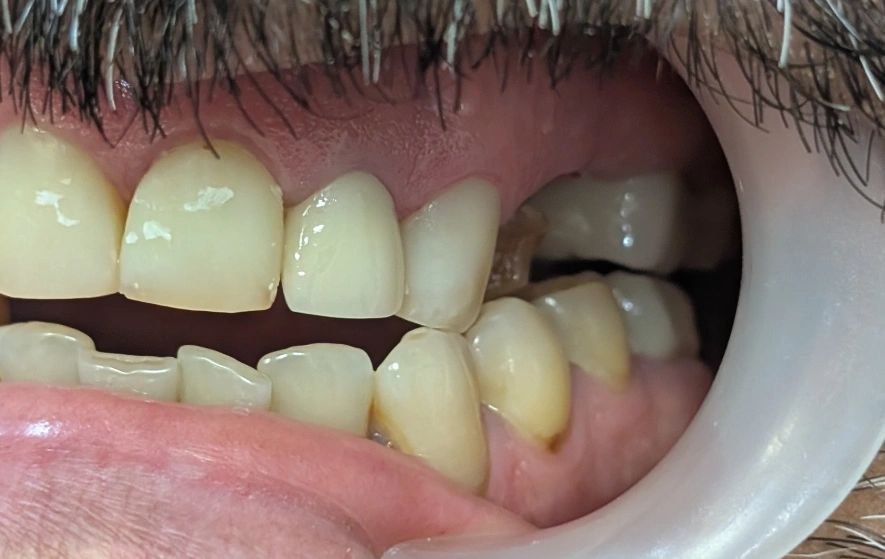
-
The patient had presented with a complaint of bothersome contact of the canines during lateral jaw movements.
His complaint was not vague; it was precise and location-specific:
«When I move my jaw left and right, my canines bother me.»
The treatment history showed that a new crown had recently been made for the upper left first molar (tooth 6).
At first glance, there seems to be no direct connection between a molar crown and involvement of the canines — but in occlusion, no change is «local».
-
On clinical examination, the decisive point became apparent:
In lateral movement to one side, the guidance pattern was canine rise,
but on the opposite side, group function was present all the way to the last posterior tooth.
That is, the two sides of the jaw were working with two different occlusal logics.
-
This asymmetry, in itself, is not necessarily pathological,
but when placed alongside the patient's newly emerged complaint after cementation of a new crown, the narrative changes.
Most likely, the previous clinician, when making the crown for tooth 6, set it out of contact in lateral movement — a decision that on the surface seems «safe», but that in practice rewrote the pattern of lateral contacts on that side.
-
And this is where the main point emerges:
The problem is not merely mechanical.
With a change in the occlusal pattern, the input data to the proprioceptive nervous system changes.
An occlusion that for years had been «invisible» to the patient's brain — that is, processed at the subconscious level of motor control — has now become a new and unfamiliar stimulus.
And any new stimulus in the occlusal system quickly crosses the threshold of habituation and enters awareness.
-
This is exactly what in the occlusion literature is referred to as occlusal awareness:
the patient suddenly «feels his own occlusion» — and this sensation, regardless of how severe it is mechanically, is bothersome.
In other words, with a single-unit restoration we have disrupted not only the force distribution but also the patient's perceptual map of his own jaw.
-
The complaint about the canines is the clinical manifestation of this rewriting;
not necessarily in the sense that the canines are overloaded, but in the sense that the patient's brain no longer recognizes the contact pattern of this side as «its own».
-
The main question is not «Is the crown high or low?»
but rather:
«Has this crown preserved the patient's familiar neuromuscular pattern, or disrupted it?»
In this case, the answer was clear.
The patient's complaint about the canines was a reflection of a disturbance in the proprioceptive inputs — a clue that the patient's natural occlusal pattern, with the making of a crown, had shifted from the subconscious to the conscious state.
-
On this basis,
the solution is not selective grinding of the canine or a temporary splint;
the treatment decision is to remake the crown of tooth 6, restoring the correct lateral contact and bringing back the familiar group-function pattern of that side — so that the nervous system again consigns the occlusion to the subconscious.
-
This case is a reminder:
Occlusion is not only a biomechanical phenomenon; it is also a perceptual one.
A change in a single unit — even a single-tooth crown in the posterior — can disrupt the proprioceptive map of the entire arch,
and the symptom often appears not from where more load is taken, but from where the patient's brain feels it for the first time.
The content of this page is intended for the educational use of dentists and dental students.