
Chairside 17
When You Must Doubt the Previous Surgery Before Starting Treatment
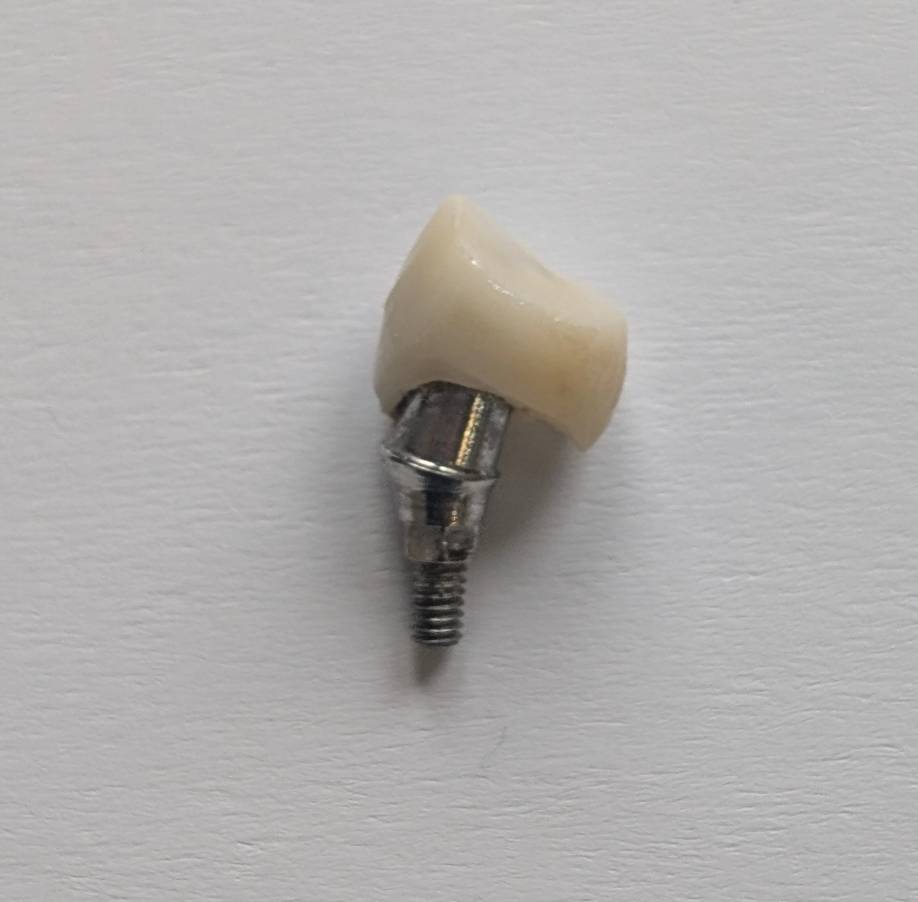
A patient had presented complaining of a repeatedly falling implant crown. The crown and abutment had been made by another dentist; but the quality of the adaptation, fit, and design of the prosthesis was so poor that even at first glance the mismatch between the crown and the abutment was completely obvious.
️Sometimes certain reconstructions are not just an «unsuccessful crown»; rather, they are a sign that the deeper layers of the treatment probably also need to be viewed with caution.
When the quality of the prosthesis is this low, one can no longer confidently assume that the surgery, the implant position, or even the choice of the implant system were necessarily done correctly. When you do not know the surgeon and the only thing you have from the previous work is a poor prosthesis, you must assume that every hidden layer of the treatment can be just as poor.
Before any decision, my first question was the implant brand. Not merely to order a component; but to determine at all whether continuing the treatment is even possible.
In many referral cases, before any impression or new design, we must know: are the removal tools, the drivers, the prosthetic components, and the impression system of that implant available? Is this system still supported? And is it worth entering re-treatment at all?
These questions are not merely logistical. Their answers determine whether it is reasonable at all to place any cost on the patient — even the cost of a radiograph. If it becomes clear at the very start that the system is unavailable or the work cannot be continued, at least the patient leaves the office without extra cost.
The next step was to request a new CBCT of the region; not only to examine the bone, but for an overall assessment of the implant's condition, angle, depth, bony support, and to record the patient's treatment documentation.
️Sometimes the CT scan is not only a diagnostic tool; it is a decision-making tool. The decision of: «Should this case be continued?»
When you do not know the surgeon of the case, you become the heir to the decisions of someone you will never see. And from the moment you begin the treatment, in the patient's mind you become the clinician of that implant; with all the consequences that may later appear.
️Perhaps one of the most important parts of implant treatment is the ability to «not start» some treatments.
The content of this page is intended for the educational use of dentists and dental students.