
Chairside 18
When an Ambiguous Finding Creates Two Competing Possibilities
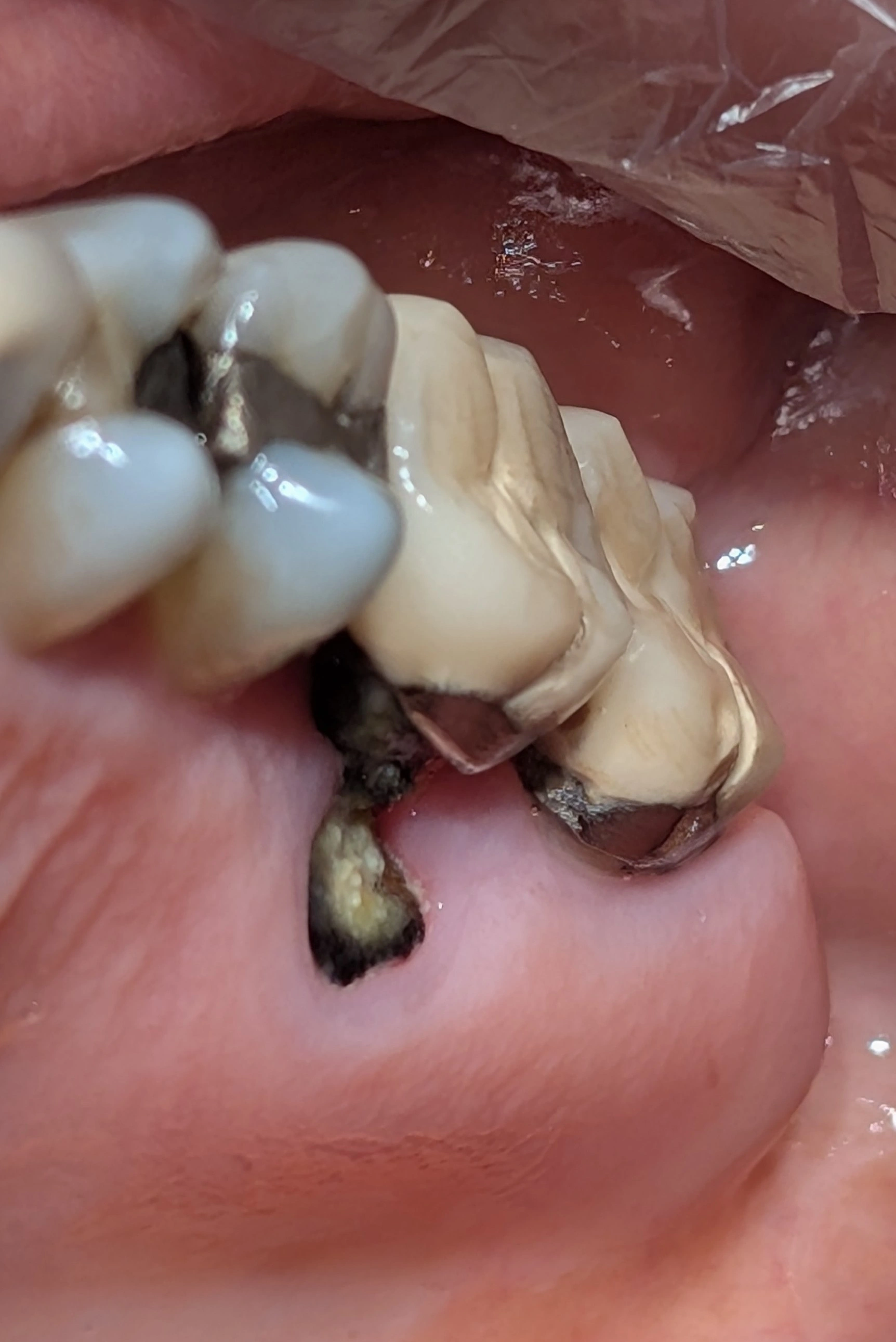
The patient presented with a posterior region whose finding was unusual: a crowned tooth, and on its palatal side, a dark, decayed root that lay outside the margin of the crown and looked like a palatal root, but separate from the crown.
The first temptation was to quickly construct a narrative: perhaps the initial clinician misjudged the extent of the tooth, set the crown margin incorrectly, and over time caries ate away the furcation region to the point where that root separated and migrated. This narrative is internally consistent and also fits the known vulnerability of the furcation of maxillary molars to submarginal caries.
But here one must pause. «Root migration» is a mechanical claim, not an observation. A root that has lost its periodontal support can move over weeks to months — but this is proven only when we compare the root's current position with its own anatomic place. Without that comparison, one cannot say with certainty that the root has truly migrated.
The second possibility is that this structure was not part of the crowned tooth at all. A supernumerary tooth in the posterior region, outside the arch, with no role in occlusion and out of reach of hygiene, can remain untouched for years until it finally decays. In that case, the initial clinician may not have set the margin incorrectly at all; perhaps from the very beginning there were two separate teeth, and the crown was correctly seated on the main tooth.
The key point is that these two narratives cannot be separated with the available data — but a single radiographic criterion can test both at once: the count and independence of the roots. If a PA or CBCT shows that the crowned tooth has its own complete, independent set of roots and this structure has no anatomic connection to it, the supernumerary-tooth hypothesis is proven. And if it shows that this root is in continuity with the furcation of the same tooth, the misjudged-margin narrative is confirmed and the supernumerary tooth is set aside.
️Sometimes the value of a case is not in its definitive diagnosis, but in honesty about what we do not yet know.
The initial inclination in this case was toward the misjudged margin — but inclination is not diagnosis. At the moment of the visit, no radiograph was at hand, and this means that whichever narrative was chosen would remain a well-dressed guess, not a documented judgment.
️Perhaps the skill we talk about least is exactly this: holding two possibilities at once, until the data needed to eliminate one of them becomes available.
The content of this page is intended for the educational use of dentists and dental students.