
Chairside 19
When the Opposing Tooth Occupies the Restorative Space
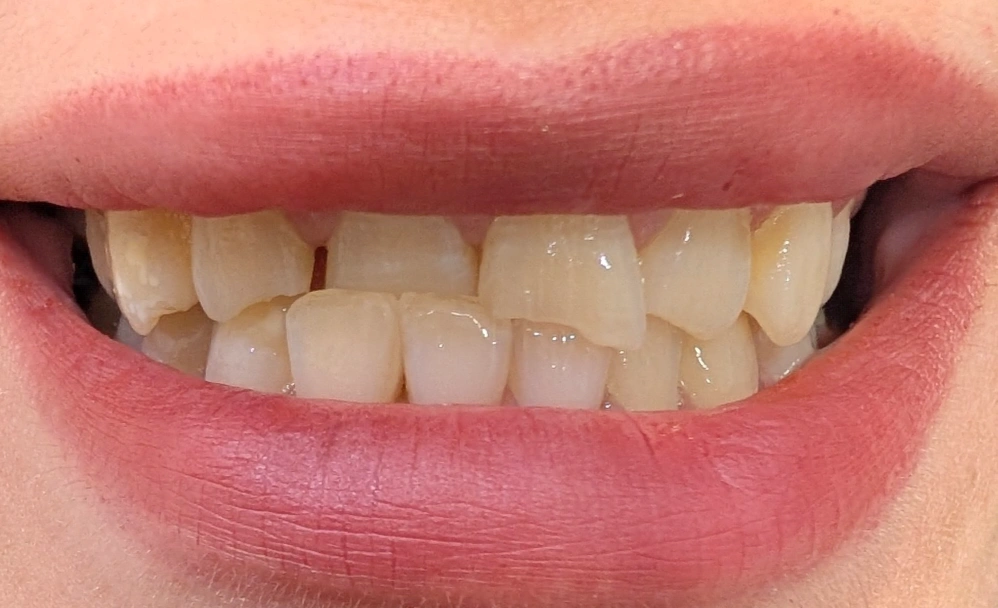
The patient presented with a history of trauma to the maxillary anterior region — a few months earlier. That blow had rendered some teeth non-restorable, including the maxillary right central, whose root was driven out of the bone by the impact and is indicated for extraction. But the main reason for today's visit was something else: deciding the esthetic fate of the maxillary left central.
The maxillary left central was fractured. What made the case complex was the opposing lower anterior tooth: having lost its antagonist, it had supraerupted and moved into the fracture space and the restorative space — that is, it had occupied part of the space needed to rebuild the upper central.
This supraeruption was dentoalveolar in type (the tooth migrated coronally together with its bone and gingiva), and because it occurred over a span of several months, it is an active process, not a stabilized state. The very fact that it moved proves that the lower tooth is vital, with an active PDL and no ankylosis.
The first step was a consultation for intrusion of the lower anteriors. The orthodontist ruled this path out, reasoning that intrusion with standard continuous mechanics depends on a deep curve of Spee, a condition not met in this case. Absolute intrusion with a mini-screw remains a feasible technical route, but it was not pursued for now.
Because the amount of supraeruption is small, the path shifted from orthodontics toward a minimal restorative correction. More aggressive options — devitalizing or extracting the lower tooth — were considered and set aside, since the severity of the case does not justify them.
The chosen solution is to split the correction between the two arches: a slight enameloplasty of the lower anteriors, plus making the upper central slightly shorter (on the order of half a millimeter). The incisal-edge position of the central was set based on display at rest, and is to be confirmed with phonetics (F/V) and the smile display as well.
The sequence toward the final plan is as follows:
- Extraction of the non-restorable teeth (the maxillary right central and similar cases).
- Creating restorative space through this same minimal two-arch correction.
- Setting the incisal-edge position of the maxilla (esthetics, phonetics, smile) and then resolving the interference with the antagonist.
- Rebuilding the maxillary left central while maintaining a stable contact with the lower tooth, to prevent relapse of the eruption.
- Deciding on the replacement of the extracted teeth, whose modality is still open and undecided.
️Sometimes the complexity of a case does not come from the lesion itself, but from a movement that occurred in the opposing arch in the absence of an antagonist — and the solution is not necessarily in the same arch where the problem is seen.
️When the severity of the problem is small, choosing the least invasive path — even at the cost of splitting the correction between two arches — is often preferable to a larger single-arch solution, provided the stability of the result is secured with a controlled contact.
The content of this page is intended for the educational use of dentists and dental students.