
Chairside 27
When a Colleague's Recommendation Is Itself Diagnostic Data
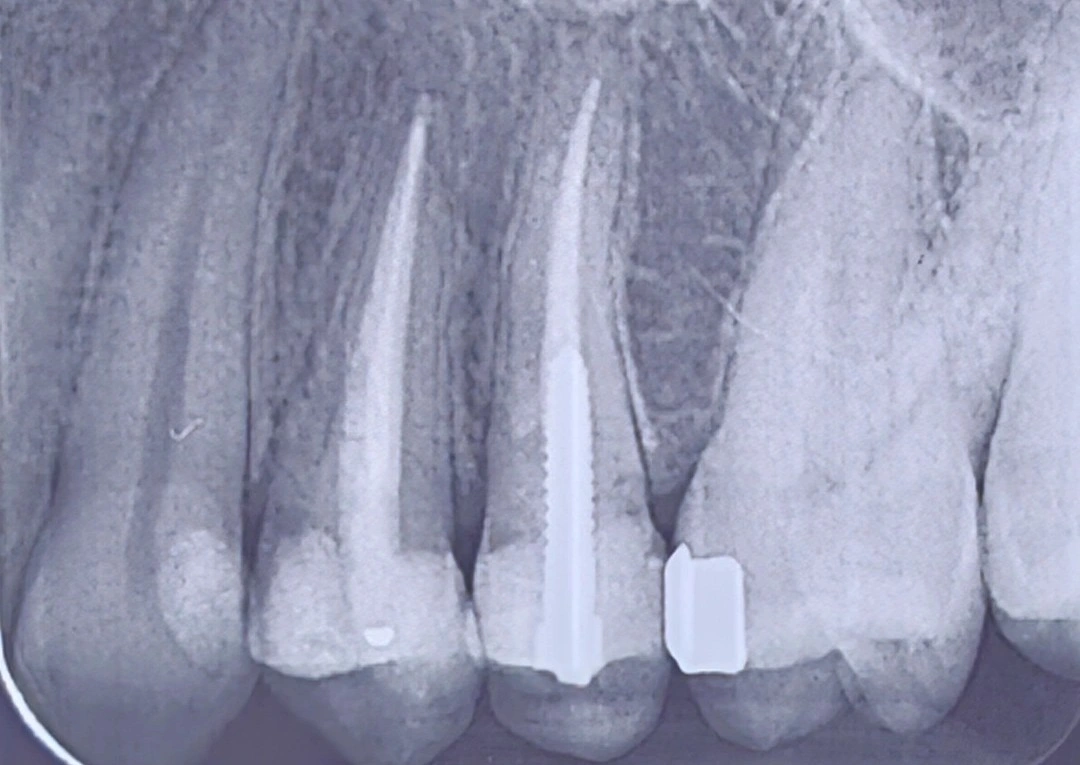
Presenting Complaint. The patient came in for a crown on the first premolar. The composite restoration had previously been placed by another colleague.
On clinical examination, the tooth's condition looked good — enough wall and height remained that reaching adequate ferrule for preparation seemed unlikely to be a problem. But the radiograph told a different story: the restoration was much larger than it looked on exam, and the tooth's real remaining structure was less than I had thought. This mismatch between the clinical view and the radiograph is what triggered the whole evaluation.
Before making any decision, I asked the patient what they wanted from the crown and how they had arrived at it. They said the colleague who placed the composite had told them the tooth's condition was very poor and that a crown was essential.
Clinical Evaluation. That recommendation was itself diagnostic data to me. Someone who places an adhesive restoration and then presents a crown as the tooth's rescue is effectively treating the crown as compensation for lost tooth structure — but a crown adds no tooth structure, and its retention and prognosis depend entirely on the structure that remains. This contradiction suggests the underlying restoration probably wasn't done to a very high standard - as if the colleague, too, had seen something during treatment that concerned them. I factored both points into the decision.
From there, the chain of reasoning was clear:
- I will not place a crown over the existing composite - both for the health of the tissue beneath it and because the restoration itself was probably not done to a very high standard; it looks like the previous dentist wanted to use the crown as a cover for that same restoration. Until I'm confident about both of these, covering it with a crown means building a prosthesis on an unevaluated foundation.
- So if a crown is to happen at all, complete removal of the composite and rebuilding the foundation is mandatory.
- And this is where the tooth's seemingly favorable condition loses its credibility. What looked like adequate height and wall thickness on exam was mostly composite. Once it's removed, a deep subgingival margin and inadequate ferrule are the likely outcome.
- At that point, two paths remain: crown lengthening to achieve an acceptable ferrule, or extraction if surgery would cause unacceptable damage to the bone and supporting tissue.
Conclusion and Clinical Tip. The tooth, as it stands, is asymptomatic and in function. In other words, what would push this case toward surgery or extraction is my own intervention, not the tooth's current state. So the decision was to leave the tooth alone for now.
I explained clearly to the patient that I will not place a crown over this restoration, that if we move forward the composite will have to be removed, and that doing so could lead to gum surgery or even extraction. Treatment was deferred until symptoms appear, the restoration fails, or endodontic treatment becomes necessary.
This decision isn't absolute — it's case-dependent. Had there been evidence of decay beneath the restoration, an active crack, or similar findings, deferring treatment would not have been justified, and the restoration would have had to be reopened.
️Clinical Tip: don't judge ferrule and remaining wall thickness from the clinical view of a restored tooth — what you see may not be tooth structure. And when a prior treatment recommendation contradicts adhesive principles, that recommendation is itself part of your diagnostic data. Sometimes the most correct intervention is keeping an asymptomatic tooth out of a cascade of successive invasive treatments.
The content of this page is intended for the educational use of dentists and dental students.