
Chairside 29
Discoloration of an Endodontically Treated Tooth, and a Crown That Wasn't Needed Yet
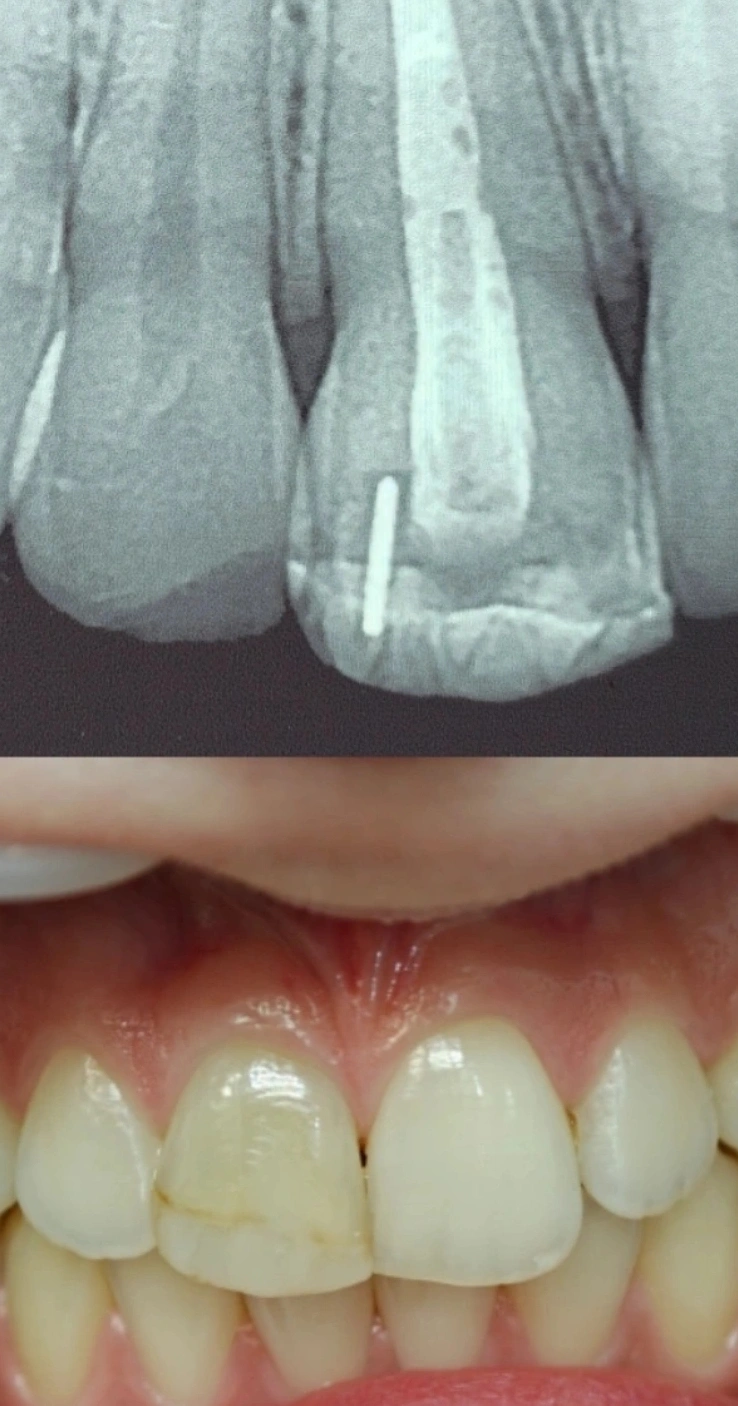
The patient came in for a crown, with a diagnosis that had already been made elsewhere. What this visit needed was not to carry out that request, but to check whether a crown was actually indicated at this stage.
Presenting Complaint. The patient presented with a history of trauma to an anterior tooth, root canal treatment, and a composite restoration. Their complaint was discoloration of the tooth. They had previously been told the solution was a crown, and they came in with that same request.
Evaluation. On the radiograph, the pulp chamber had not been cleaned out and gutta-percha remained in it. This finding explained the discoloration: the discoloration had an intrinsic origin, and its cause was identifiable and treatable — not a fixed condition that could only be covered up.
On clinical exam, more than three-quarters of the tooth's crown still retained its natural structure and texture. That matters on an anterior tooth. Rebuilding the natural texture of enamel with a crown is not a simple task, and in practice, this level of detail is usually not pursued anyway. In other words, preparation would sacrifice something whose replacement was not guaranteed.
Decision. Crowning this tooth at this stage carried two costs: removing sound structure and texture, and steering the patient toward a path of more invasive treatment — since there is no going back after preparation, and any subsequent problem starts from a higher level of intervention. Against that, the cause of the discoloration was identified, and the less invasive option had not yet been tried.
I referred the patient to a restorative specialist for internal bleaching and replacement of the composite restoration. From this point, the treatment decision is theirs: if they judge internal bleaching suitable, they proceed with it, and if needed, they review or repeat the root canal treatment as well. If for any reason they conclude this path isn't workable, the patient returns for a crown.
️Clinical Tip: when a patient presents with an already-made diagnosis and a specific request, the first move is not to accept that request. Discoloration alone is not an indication for a crown, especially when its cause is identifiable and treatable. Preparation is a one-way decision — there is always a later chance to place a crown, never a chance to bring back the structure that was removed.
The content of this page is intended for the educational use of dentists and dental students.