
Chairside 33
Space-Distribution and Biomechanical Challenges in the Presence of Active Apical Infection
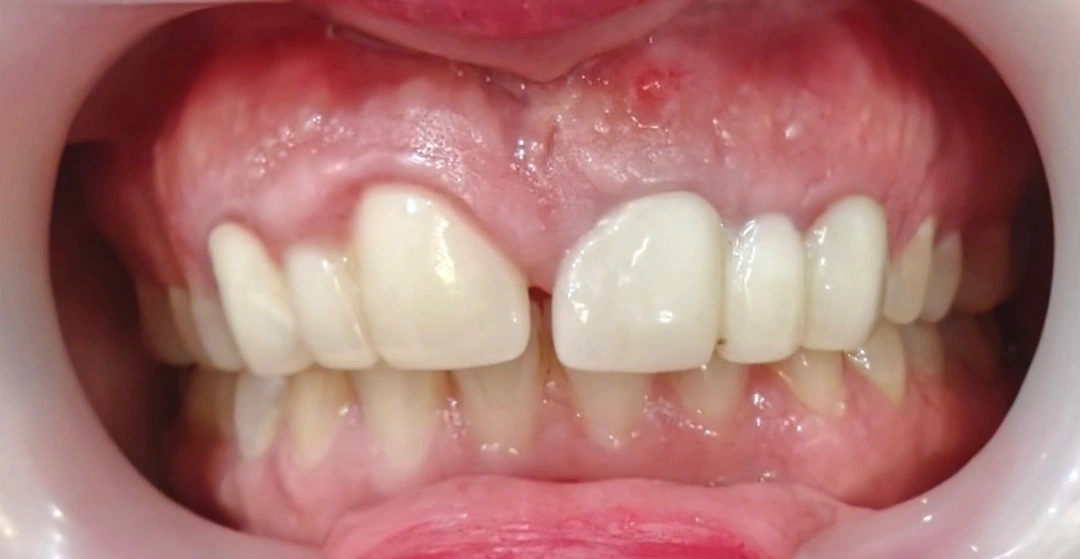
The patient had arrived under severe time pressure to have the anterior bridges replaced today and the smile corrected; but an active sinus tract over the left central, and oversized centrals beside narrow lateral pontics, showed that the problem was not merely the look of the crowns. This visit was about separating the apical infection from the poor space distribution — and declining to start immediate esthetics on a foundation that had not yet been assessed.
Presenting Complaint. The patient (under severe time constraint) presented complaining of an unattractive smile and asking for the current bridges to be removed and esthetic treatment to be started immediately. In the history, the maxillary left central incisor (tooth 21) had a history of infection and apical surgery, currently accompanied by an active sinus tract in the mucosa.
Evaluation. The clinical condition of the teeth and of the space distribution was severely compromised. Several gross errors in the previous treatments were apparent:
- Failed root-canal treatment of tooth 21: radiographically, the previous apical surgery had been entirely unprincipled. No retrograde filling had been placed to seal the root end; the procedure had been limited to opening and drainage. As a result, bacteria remain active in the root-canal system and the tooth is a candidate for extraction.
- Poor space management: the present central incisors are severely oversized, and even so the midline diastema has not been closed. The lateral incisors are very narrow and designed as pontics. The evidence shows that the patient originally lacked lateral incisors and had a wide diastema. The previous treatment attempted to fill the space by unnaturally enlarging the centrals, which has failed completely from an esthetic standpoint.
- Assessment of the cause of the diastema: the patient's claim that the diastema appeared after the abscess is rejected on biomechanical grounds. A symmetrical diastema exactly on the midline, between two separate bridges, cannot be merely the consequence of a periapical lesion; it is rooted in the original space-distribution problem.
Decision and Treatment Plan. The patient's request to start immediate esthetic treatment on the present abutments was firmly declined.
The patient was told that tooth 21 is not restorable. Even so, even with extraction of tooth 21, esthetic correction is not possible because of the position of tooth 11 (the maxillary right central).
The proposed treatment plan (given the severe drop in prognosis if orthodontics were used) is contingent on removing the bridges and carefully evaluating tooth 11. If tooth 11 is also unrestorable or has a poor prognosis, two implants can be placed with principled spacing and space distribution, addressing the esthetic and biomechanical problems at the same time. Otherwise, without space correction, the patient's esthetics will remain deficient for life.
️Clinical Tip: in anterior esthetic treatment, problems rooted in poor space distribution and missing teeth are not solved by merely replacing crowns or bridges. Ignoring the biological foundation (such as active apical infections) and yielding to the patient's pressure for rapid treatment only leads to more complex failures and the long-term loss of the patient's trust.
The content of this page is intended for the educational use of dentists and dental students.