
Chairside 38
Visit Report: Abutment Screw and Ceramic Fracture in a Maxillary Implant Bridge, in a Patient with a Mandibular Overdenture
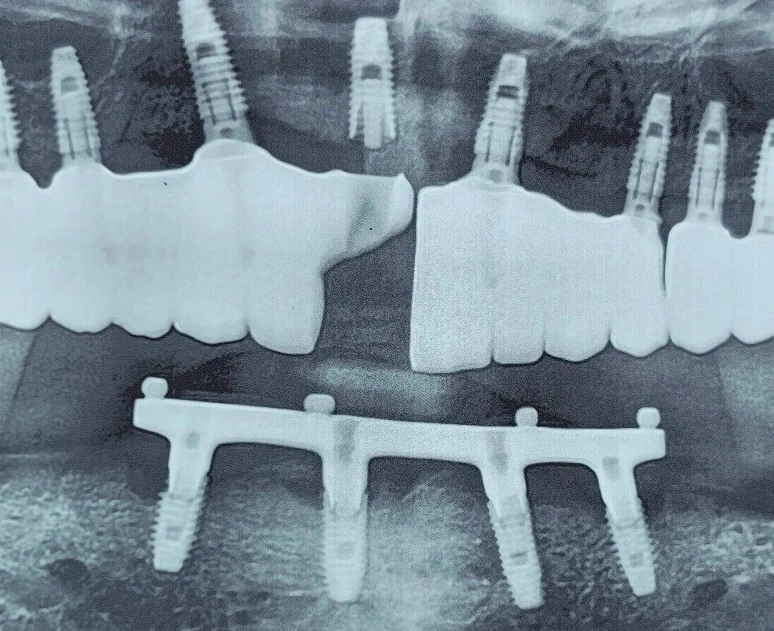
The patient at presentation
The patient came in with a fracture in the maxillary implant bridge. In the lower jaw they had an overdenture on a bar. On examination it became clear that the abutment screw had fractured, and that the crown — together with the abutment and part of the ceramic — had separated from the bridge. The fracture pattern of the ceramic was the pattern of a fracture caused by impact, not of gradual wear.
Identifying the cause
I asked the patient whether their mouth had taken any blow. The answer was a firm no, and they said it had happened simply while eating bread. But a ceramic fracture of this kind cannot be explained without an impact, and a screw fracture too usually follows a period of loosening that the patient should have noticed.
Here I arrived at a point that does not come to mind at first: the source of the impact can be the superstructure of the mandibular implants itself. I asked the patient whether they take the overdenture out at night, and the answer was yes. With the overdenture out, when the mouth closes, the metal bar on the mandibular implants comes into direct contact with the ceramic prosthesis of the upper jaw. These repeated nightly contacts have, over time, struck the ceramic and caused it to crack and fracture. The same impacts also loosened the abutment screw; the patient did not notice the looseness and went on chewing, and eventually the screw fractured under fatigue loading and the crown separated.
This is the first stage of every visit: until we know exactly what happened, the treatment cannot be effective, because the same factor will produce the same problem again.
The treatment plan
The aim was not to impose a large cost on the patient, so we take the treatment forward stage by stage and decide at each stage on the basis of the findings:
- First, a radiograph is taken of the fixture in question to make sure the fixture itself is sound. If the fixture is not fractured, removing the remainder of the broken screw is not a complicated job.
- The excess and fractured portions of the ceramic around and at the site of tooth 1 are corrected. I cut and separate these parts the way one removes a crown.
- The bridge on the upper right stays in place untouched. Only the site of tooth 1 is left empty, and a single crown on the implant is made for it.
If everything goes as expected, the treatment ends along this path. If a problem is seen at any stage (damage to the fixture, for instance, or the bridge proving impossible to correct), the whole upper right bridge has to be removed and remade.
The content of this page is intended for the educational use of dentists and dental students.