
Chairside 57
Vague pain in the maxilla; when a previous diagnosis narrows the examination
∆ 1. Case history and the earlier referral
A patient presented with vague pain in the left maxilla. Before seeing me, she had been examined by an endodontist and told that the wisdom tooth was probably the cause of the pain and should be extracted. Caries in one of the premolars had also been diagnosed, and the patient had been referred to me to treat that same caries.
∆ 2. Clinical examination and findings
On examination I confirmed the caries in the premolar. I explained to the patient that this caries needed treatment, but that it did not appear to be the cause of her current pain. I also examined the wisdom tooth. It had no contact with the opposing tooth, there was no evidence of food impaction, and its clinical condition was not such that the pain could be attributed to it. Extraction could nonetheless still be considered as a treatment option. I emphasised to the patient that she should not expect the pain necessarily to resolve by extracting the wisdom tooth or restoring the caries.
I tried to reproduce the patient's pain by examining different areas. I checked the interdental contacts with floss to assess the likelihood of food impaction and periodontal involvement. I also examined the gingiva with probing, but none of these investigations could reproduce the patient's main pain.
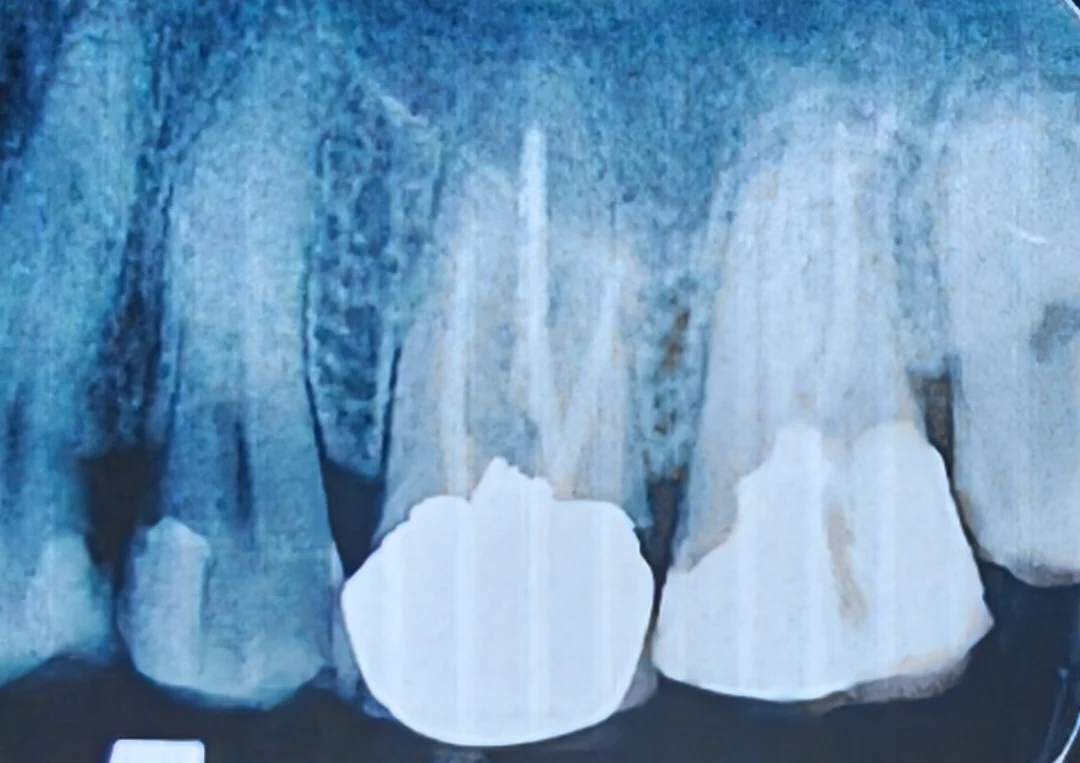
The first molar, which carried a crown, was also examined. Clinically the crown was not in good condition, and recurrent caries was visible at its margin. I explained to the patient that the crown on tooth 6 was of poor quality and that its root canal treatment was not radiographically satisfactory either; but I did not think that correcting these problems could resolve her current pain.
∆ 3. The blind spot in my examination
There was an important point in the course of my examination. Because the patient had previously been examined by an endodontist, I unconsciously assumed that the endodontic assessment had been carried out in full and that the possibility of an endodontic cause had already been examined and ruled out. It was this assumption that kept me from carrying out, with enough care and priority, some of the clinical examinations that also matter in a routine prosthodontic examination.
∆ 4. Reproducing the pain by apical palpation
Clinical tip
In the end I decided to examine the area again, without relying on the previous diagnosis. On palpation of the apical area of the upper left tooth 6, the patient immediately reported her severe, familiar pain. This time I could reproduce the chief complaint in the very tooth in which suspicious clinical and radiographic findings had already been seen.
∆ 5. Referral and treatment plan
I referred the patient to an endodontist for assessment and endodontic treatment. In the referral letter I stressed that the patient's main pain is clearly reproduced by palpation of the apical area of this tooth. I also noted that, given the recurrent caries and the poor condition of the crown, prosthetic reconstruction and a new crown should be planned once the root canal treatment is complete.
The point this visit left with me
My mistake was that I let the previous information and diagnosis narrow the course of my examination. Because the patient had previously been seen by an endodontist, I unconsciously assumed that the endodontic assessment had been carried out completely and that there was no need to examine the possibility of endodontic problems in the other teeth with the same care.
On the other hand, because the referral was for caries treatment, my focus was more on the problems that had been identified from the start. In effect, instead of starting the examination from the patient's chief complaint and assessing every possibility independently of the previous diagnosis, I shaped part of the examination path around the information I already had.
This experience reminded me again that even when a patient comes with a previous diagnosis and a specific referral, we should not limit our own independent examination to that diagnosis. The history, palpation, percussion and the other clinical tests should be carried out systematically, based on the patient's complaint; even if we assume that another specialist has already checked all of these.
Sometimes what stands in the way of a diagnosis is not a lack of knowledge or equipment, but the initial assumption that, without our noticing, directs the rest of our examination.
This page is intended for educational use by dentists and dental students.