
Chairside 08
Excessive Ridge Display in a Patient Seeking a Denture
-
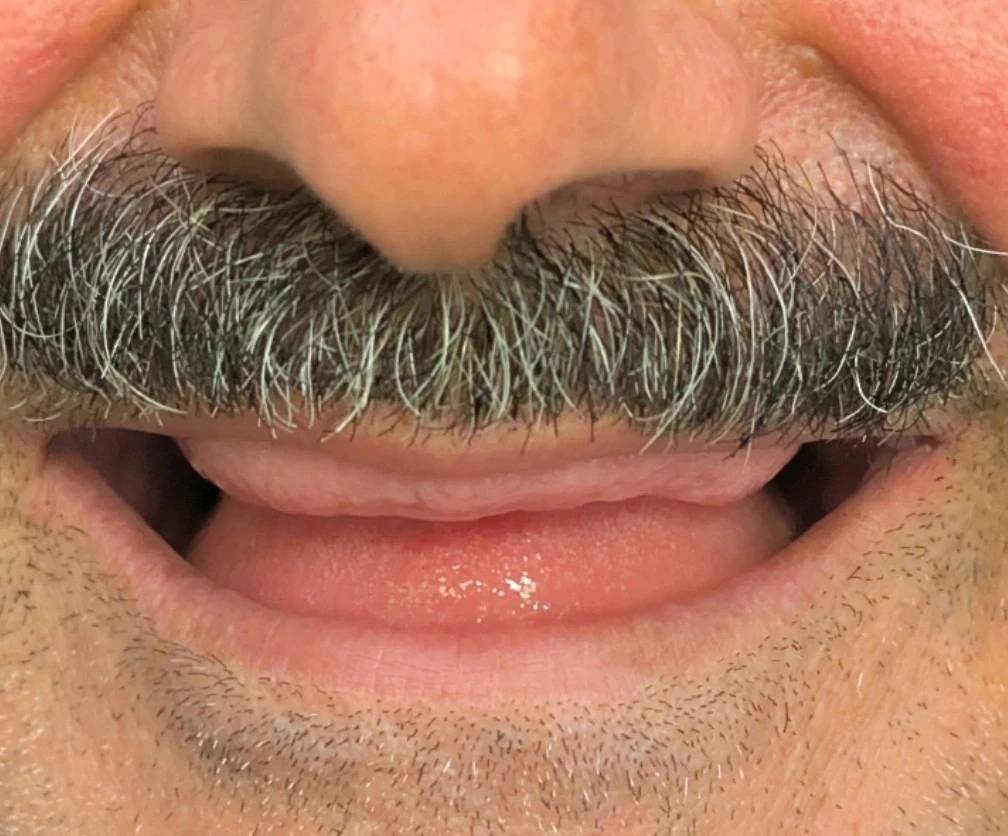
The patient had presented for removable prosthesis treatment. At first glance, and even without a denture in place, a few millimeters of the gingiva and maxillary ridge were visible with the lip at rest, and a much greater amount in the smile.
This degree of ridge display, before any reconstruction, is considered an unusual and notable finding in the initial assessment.
-
Given this situation, one can surmise that before losing the teeth the patient probably had a high lip line or a kind of gummy smile.
Nevertheless, in treatment decision-making, the main issue is not the patient's past; rather, it is the final outcome of treatment, which must be anticipated from the start.
-
In a removable prosthesis, the acrylic base and the artificial teeth are placed on this very ridge.
As a result, any degree of ridge display not only does not decrease after treatment, but, because of the thickness of the base and the bulk of the prosthesis, will appear more prominent and bulkier in the lip view.
-
In such conditions, the risk of creating a bulky and unnatural appearance esthetically will be high;
and this can ultimately lead to patient dissatisfaction and even rejection of the prosthesis.
-
In this case, before entering the prosthetic phase, attention must be paid to modifying the foundation.
If there is a decision for implant-based treatment (for example, an overdenture), it is necessary beforehand to consult the surgeon about performing osteoplasty for reduction and reshaping of the ridge.
Creating adequate space not only helps improve esthetics, but also makes it possible to design the prosthesis with a more logical contour and a better prognosis.
-
This case is an important reminder that in prosthetics, it is not only the replacement of teeth that matters;
the underlying foundation and how it is seen in the smile are part of the final outcome of treatment.
Sometimes the best prosthetic decision begins in the operating room.
The content of this page is intended for the educational use of dentists and dental students.