
Chairside 09
Decision-Making in a Tooth With an Uncertain Prognosis Before Entering Definitive Treatment
-
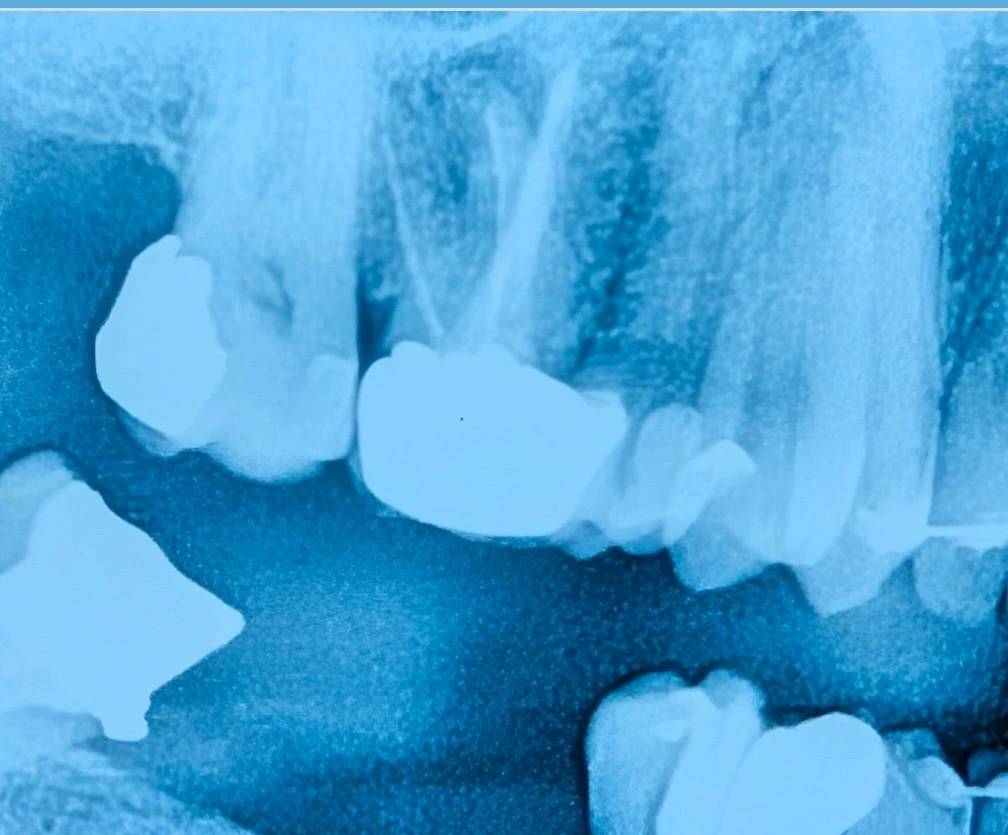
The patient had presented for the treatment plan of the upper right first molar (tooth 6). This tooth had a crown and, at the same time, there was evidence of underlying problems — including the need for root canal re-treatment.
At first glance, the treatment path may seem clear: root canal treatment, a build-up, and a new crown.
-
But the main question is this:
Do we really know what tooth we are dealing with?
-
In such conditions, not only can the existing crown conceal the true status of the tooth,
but even after the crown is removed, the underlying caries may create an incorrect picture of the amount of remaining tissue.
Sometimes the caries does not allow us to determine how much of the tooth structure is sound and reliable;
and making a decision without completely removing this caries would merely be a decision based on an incomplete assessment.
-
In this case, before any definitive decision, the old crown was removed and all caries and previous restorations were completely removed.
This step creates a true exposure of the tooth's condition.
-
At this stage one can more precisely assess:
how much healthy tissue remains, whether there is an acceptable ferrule, and fundamentally whether this tooth is worth entering a multi-stage treatment path or not.
-
If necessary, after this true exposure repeat imaging is performed to obtain a more precise assessment of the condition of the root and the remaining structure.
It is at this point that the true prognosis becomes clear;
and the decision — preservation or replacement — is made on the basis of reality, not guesswork.
-
This approach prevents performing unnecessary treatments and spending money on a tooth with a poor prognosis.
This case reminds us that in unclear cases, merely removing the crown is not enough;
it is the complete removal of caries that reveals the true picture.
Sometimes the diagnosis comes from removing the very layers that have concealed the truth.
The content of this page is intended for the educational use of dentists and dental students.