
What Is a Split (Two-Piece) Cast Post and Core, and When Is It Used?
فارسیExplanation of the split cast post and core concept, its two common designs, and its indications; based on the case report by Bansal et al., Case Reports in Dentistry, 2016.
After DentCast Plus 12, a lot of questions came in about exactly what this split post and core is. Here is the short version:
When a molar is destroyed to the point that no cavity wall remains, several treatment paths are open. One of them is an intraradicular post for core retention. Sometimes one post alone is not enough, because the core either rotates or fails to gain the retention it needs. The answer is not a longer post either, since a long post raises the risk of perforation and internal root stress. Two shorter posts in two canals perform better than one long post.
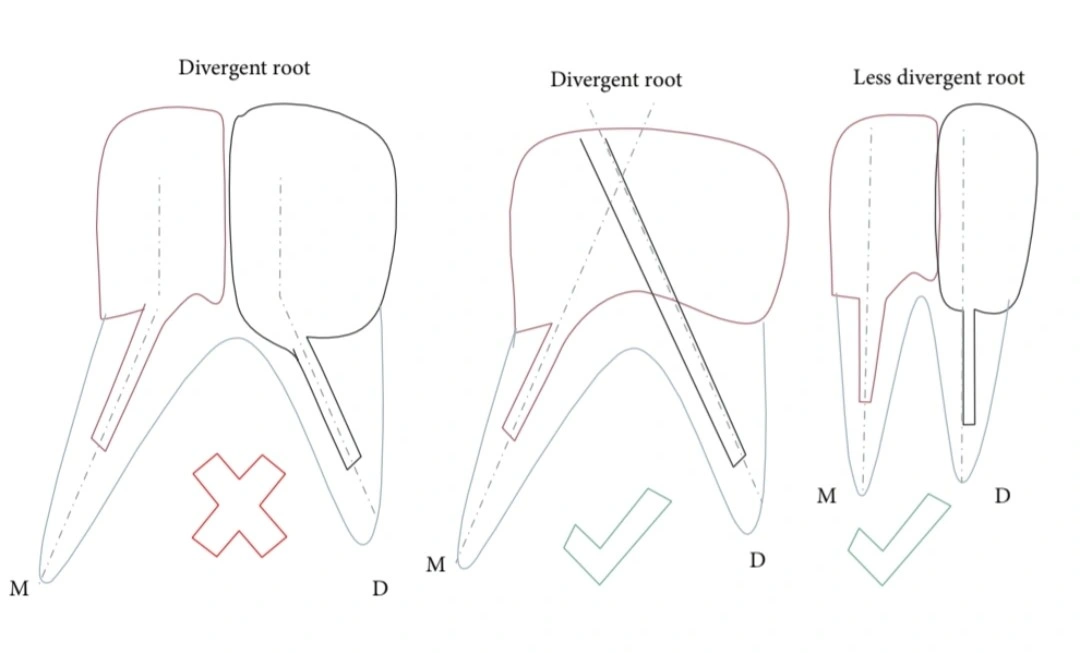
Here is the problem: molar roots are divergent, so the two posts do not share one path of insertion, and the post and core cannot be cast as one unit. To solve this, the post assembly is split into two pieces, each with its own independent path of insertion.
Two Designs
There are two designs:
- Multisection: the core is divided into two segments, each carrying its own post with an independent path of withdrawal. One segment is cast and tried in first, then the second segment is built in the mouth against the first. If both segments seat on ferrule and are fully encased under the crown, they don't even need a dovetail lock between them, since the crown itself holds them together.
- Single-piece core with an auxiliary post: a single-piece core with a short post is fabricated in one canal, plus a separate post in the other canal that slides through a hole in the core. The core and its main post are cemented first, and the auxiliary post is immediately slid in through the hole.
Which Design to Choose
Which design? The degree of divergence decides. In mild-to-moderate divergence, multisection works. In severe divergence, multisection no longer works either, because the axes of the two segments no longer align, and building the pattern produces undercut and interference during wax pattern fabrication. Here the second design is chosen. (Translator's note: the source says wax pattern; in the clinic today we mostly use resin patterns.)
Indications
The indication rests on three conditions:
- The crown is destroyed to the point that the core cannot gain retention from coronal structure, but ferrule (a sound band of dentin around the tooth, above the preparation margin) is present
- A single post may not provide enough retention and anti-rotation. With divergent canals, retention is better provided by two relatively short posts, one in each canal. (In my opinion, this also applies to roots where we cannot build a post of sufficient length.)
- Root divergence does not allow a one-piece pattern to be fabricated
If the third condition does not hold — that is, the roots are not divergent — an ordinary one-piece post and core does the job.
Practical Notes and Limitations
Two practical points:
When choosing a canal, look at the surrounding dentin thickness. In a lower molar, for example, the mesiobuccal canal is preferred over the mesiolingual, because more dentin remains around it in the danger zone.
And the limitations: it is technique-sensitive, adds extra appointments and lab steps, removes more tooth structure, and makes future retreatment harder.
Source: Bansal R et al., Case Reports in Dentistry, 2016. Note that this is a case report, not a survival study. All the available evidence on this technique is of that same kind.
"Management of Grossly Decayed Mandibular Molar with Different Designs of Split Cast Post and Core"
Rashmi Bansal, Mehrotra N, Chowdhary P, Gurtu A — Case Rep Dent. 2016;2016:2976941
DOI: 10.1155/2016/2976941