
Insight — Space Management for an Anterior Implant in a Deep-Bite Patient
Clinical Insight
Managing occlusal limitations without the need for complex orthodontic treatments.
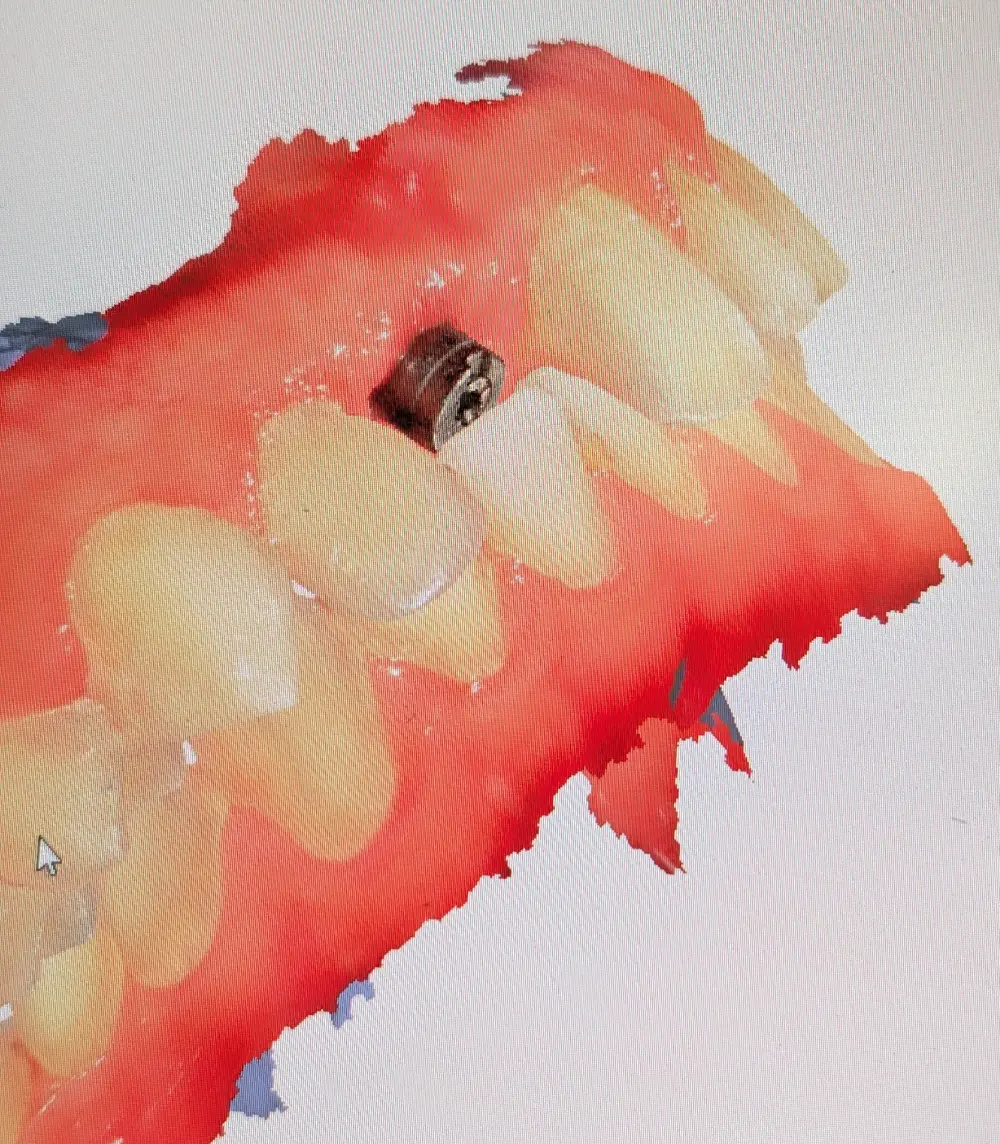
In this case, a patient with a severe deep bite and a central-incisor implant had been referred for orthodontic evaluation, but came to me to assess the possibility of managing the space without orthodontics.
The most important challenge in restoring the central-incisor implant was the limitations caused by the deep-bite occlusion, which is also clearly visible in the image.
1️⃣ A correct understanding of the space limitation
In deep-bite patients, we must always be aware from the start that fabricating an ideal all-ceramic restoration is not always possible, and we should not have tunnel vision.
If the functional space is insufficient:
- We must consider PFM as a fully valid and durable option.
- Especially in the palatal region, using a metal surface (Metal Palatal) can reduce the required thickness.
- This choice both provides greater resistance and gives us more space.
This is part of the initial thinking of space management in such cases.
2️⃣ Choosing the type of connection
Because of the space limitation and the need for better control of the available space, a screw-retained restoration is the more logical choice.
My preference is to use a Ti-base, for the following reasons:
- Higher accuracy (fit)
- Better integration in the digital workflow
- Greater reliability compared with UCLA (fully plastic) in limited spaces
3️⃣ What if the space is still insufficient?
If, after choosing the restoration and the connection, the space is still insufficient, mild enameloplasty of the lower anterior teeth is the final solution.
This intervention:
- is simple, fast, and predictable.
- requires far less time than orthodontics.
- does not increase the complexity of the treatment.
This small correction can create acceptable space for the prosthetic reconstruction, without the need to put the patient through a full orthodontic process.
️ Final summary of the case
In this deep-bite patient with the challenge of limited space, the decision pathway was as follows:
- From the start, PFM with a metal palatal was kept in mind as the durable solution.
- A screw-retained connection with a Ti-base was chosen for its accuracy and better control.
- And only if needed, mild enameloplasty of the lower anterior teeth is used as a supportive measure.
The content of this page is intended for the educational use of dentists and dental students.