
Insight 105 — Ferrule in a Partial Denture Abutment: Why the Old Crown Has to Come Off
I have talked about ferrule a lot on DentCast, and in “Ferrule in Bonded Restorations: One Word, Three Different Concepts” I looked at ferrule in endocrowns and overlays. The point I relied on there was that ferrule matters where the load is oblique. Under axial load, preparing for a ferrule is more cost than benefit; but once the load turns oblique and creates leverage, ferrule really earns its place. And this is not specific to one particular tooth; it holds for any tooth that takes oblique loading.
One place where this becomes very, very important is the abutment tooth of a removable partial denture. Through the rest and the clasp, this tooth is constantly under oblique, lever-like forces, especially in free-end designs, where movement of the base on the ridge transmits torque to the abutment. In other words, a partial denture abutment is exactly in the situation where ferrule is decisive.
Now suppose the abutment already has an old crown. We do not know with what ferrule, or with what quality, the previous dentist made it. It may even be a very good crown, yet the ferrule underneath may be borderline and the tooth may simply have survived until today. There is a point here that usually goes unnoticed. If the importance of ferrule lies in oblique loading, a tooth that has served the patient for years may never have been under oblique load at all. So the fact that it has had no problems for years says little about its future under a partial denture. Only once the partial denture is in place does the tooth show its real condition.
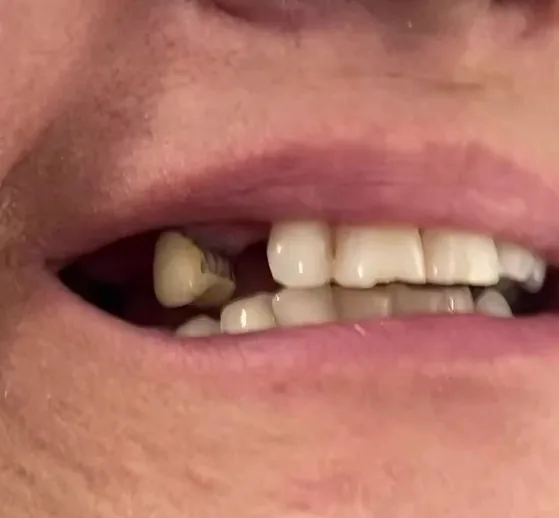
That is why, when we are going to make a partial denture, we always remove the old crown completely to settle the treatment plan, look at the ferrule, and take no risks. We should also keep in mind that our criteria in fixed and removable partial prosthodontics are not the same. In fixed restoration we may crown a tooth with a borderline ferrule and get a good result, but that same borderline ferrule may not be enough under a partial denture.
The same logic leads to another conclusion. A partial denture abutment is one of the cases where, even if we have two adjacent crowns, it may be better to splint them together, because both are under heavy non-axial forces; with splinting, that load is shared between two teeth and neither has to bear the leverage alone.
In short, the partial denture abutment is one of the clearest places where ferrule is decisive. We remove the old crown and look at the ferrule, because a tooth that has worked without problems for years may only show its weakness under a partial denture.
This page is intended for educational use by dentists and dental students.