
Insight 108 — Reverse Smile Arc in a Lab Mock-up Design
The question
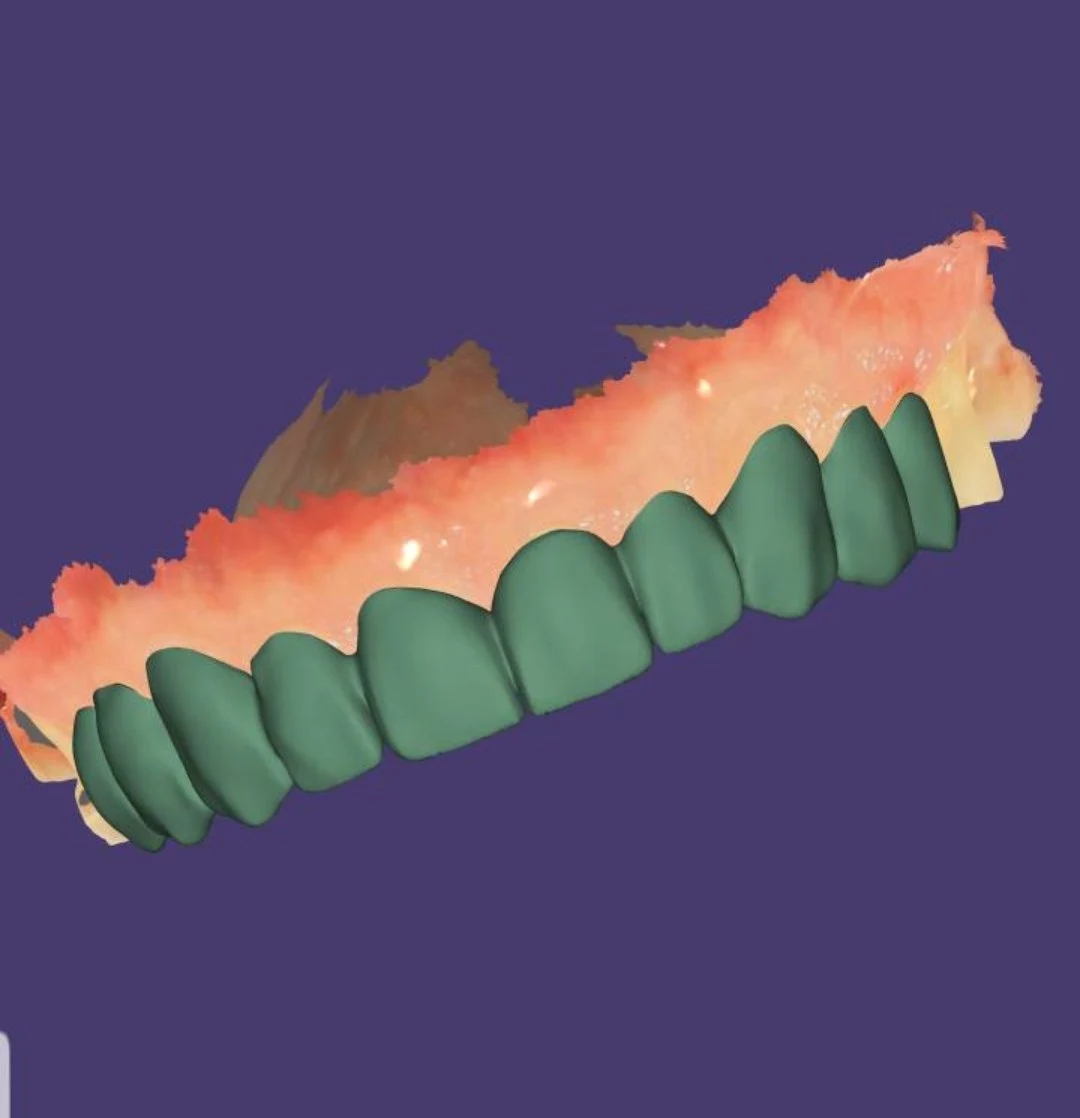
The lab has sent a digital mock-up design and asked whether it is suitable for the mock-up. Is this design acceptable?
The answer
At first glance, this design has a reverse smile arc. In the smile arc, the curvature of the incisal edges of the maxillary anterior teeth is compared with the curvature of the lower lip during a smile. The ideal is for the two to be parallel. If the edges lie on a straight line, the arc is flat; if the curvature runs against the lower lip, it is reverse.
In the literature, the crown lengths of the central and the canine are taken to be roughly equal. Because the gingival margin of the canine sits slightly higher than that of the central in many patients, with equal lengths the canine tip falls slightly higher than the central edge, and this small difference creates the desirable curvature. In this design, the centrals are shorter than the canines and the posterior teeth, and that is why the arc is reversed.
The reason for this was clear in this patient. I had not told the lab the central length. When this length is not specified, the lab usually sets an overbite of about half a millimeter against the lower anterior teeth, because it does not know where the edge of the upper teeth should be. I knew the patient from before, and I knew the current anterior crowns were going to be replaced and the centrals needed to be longer. Since I am doing a full reconstruction, at this stage I only asked the lab to make the centrals longer.
If I had not known the patient beforehand, I would have examined the mouth first, because the problem might have been long posterior teeth rather than short centrals. In any case, this is only a mock-up. I will check and adjust the final length in the mouth and give the lab the exact number. Even so, it would have been better to specify the central length to the lab too, from the start.
This page is intended for educational use by dentists and dental students.