
Insight 117 — Implant Abutment Hex Does Not Engage: A Wrong-System Choice in the Laboratory
This piece continues Chairside 48 — When the Abutment Position on the Printed Cast Differs from the Patient’s Mouth.
In that visit I wrote that the abutment in the mouth sits about half a millimetre lower than the abutment on the printed cast. The crown had no problem on the cast, but in the mouth it was short by the same amount. At the time I attributed the cause to incomplete seating of the scan body during scanning, but a question mark remained for me: incomplete seating of the scan body can hardly produce a discrepancy of half a millimetre to one millimetre.
The implant was from the Ufit system, and I had taken the scan with a Mini Biotem scan body. The gingiva in the area was deep, and when tightening the abutment I could not feel the connection engage. So I would place the abutment inside the crown, set the crown in its place, and then tighten the abutment screw. In effect, I was using the crown as a guide to seat the abutment.
After several visits back and forth, the last work the laboratory sent was very poor. This time I gave local anaesthesia and retracted the gingiva to make sure the abutment seated fully. Whatever I did, the hex did not engage, while the screw would tighten.
I placed the scan body again to take a new scan and send the case to another laboratory. Even though the scan body belonged to another system, it mated and tightened very well. That struck me as strange.
I placed the scan body, the laboratory-made abutment, and the crown with the abutment we used to maintain the healing side by side. The connection of the laboratory abutment was not the same as the connection of the healing abutment, which seated correctly on this same implant. The hex of the laboratory abutment was smaller. For that reason the abutment went into the connection but did not lock, and the screw tightened it in whatever position it happened to be. The seating geometry of the abutment also differed from the implant's real connection. The crown being short in the mouth came from this as well, not from the scan.
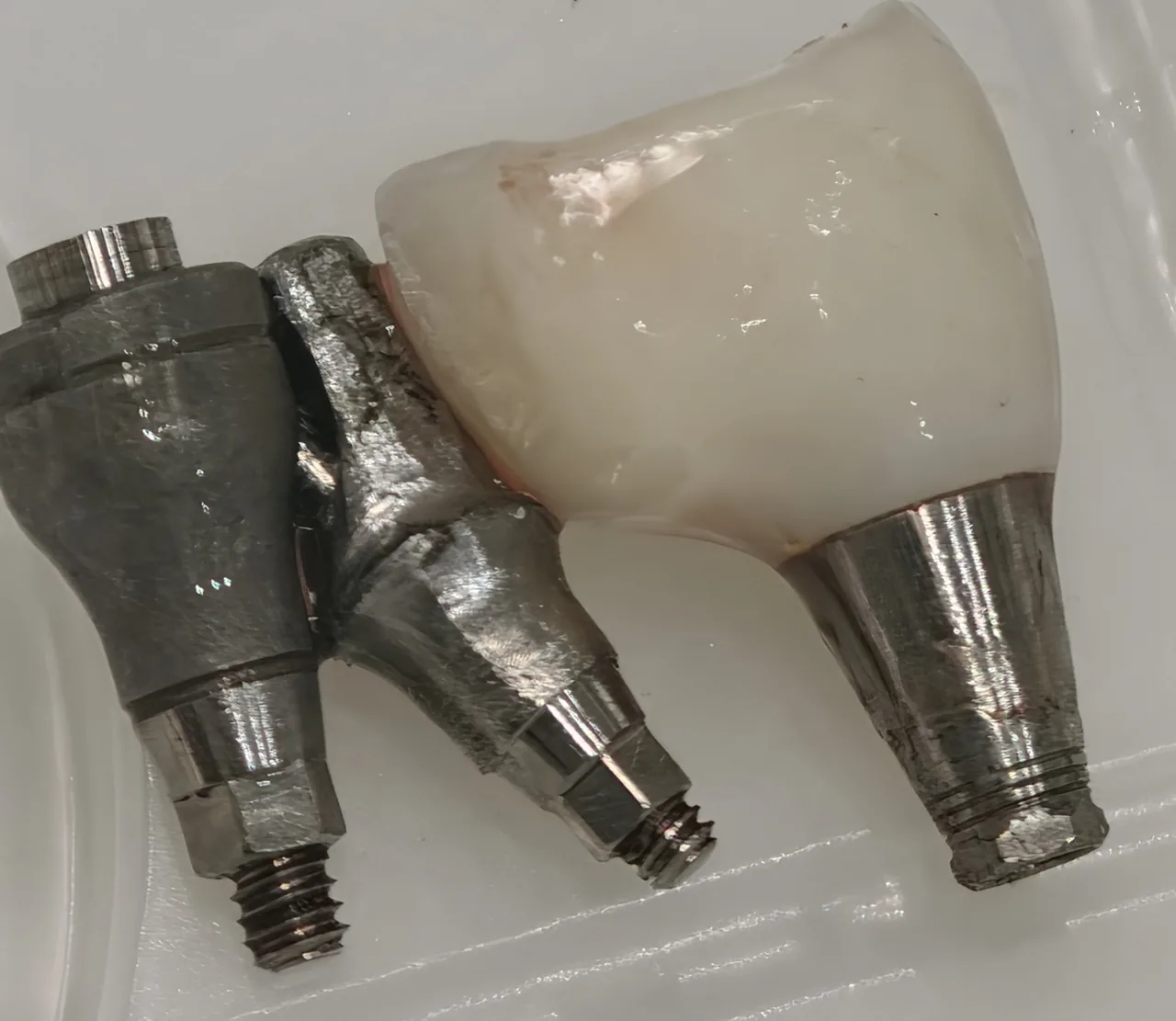
I raised the matter with the laboratory. They checked it and accepted that the mistake was theirs. I had written «Ufit» on the work order, and they had taken it to be the DIO UF system. From the very beginning, the part and library of another system had been selected.
Using the crown as a guide had also hidden this error. When the crown seats in its place through its contacts with the adjacent teeth, there is no longer any way to tell that the hex has not engaged.
Clinical tip: When the abutment screw tightens but the anti-rotation does not engage, the first thing to check is whether the fabricated part is actually compatible with the implant system. Directly comparing the connection of the laboratory abutment with a part that seats correctly on the same implant is the fastest way to find the source of the error.
What stayed with me: I had considered the laboratory error-free in this respect. That made me accept full responsibility from the start and look only for my own error. It was a kind of tunnel vision. Now, when I face a problem of this kind, before attributing it to myself, I check every stage of the work.
This page is intended for educational use by dentists and dental students.