
Insight — Restoring the Correct Vertical Dimension
Clinical Insight
When the posterior stop is lost, the likelihood of failure in the anterior region rises.
Clinical summary
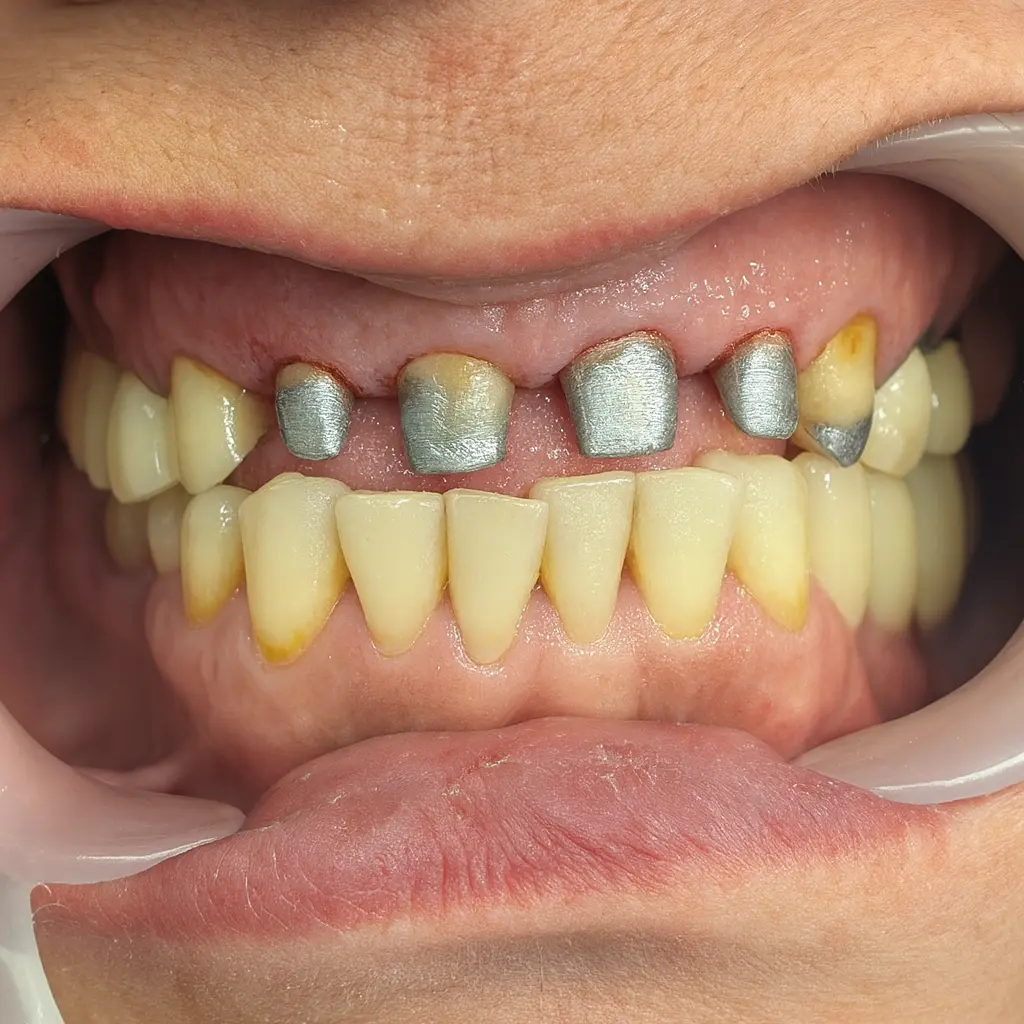
The patient presented with severely decayed anterior teeth; teeth that had previously been so-called «beautified» with composite veneers by a non-dentist. The absence of any posterior support had placed all the functional forces on the anterior teeth, and the possibility of reconstructing the anterior region had become challenging.
The treatment path
The posterior lower-left and posterior upper-right regions were implanted to re-establish the posterior stop structure.
After removing the caries, the anterior teeth, because of the depth of destruction, all required root canal treatment and shortening to accommodate post and cores.
After removing the anterior caries, because of the loss of the Vertical Dimension, the patient's bite had become «closed».
Before delivering the post and cores, temporary crowns were placed on the implants to restore the VD to its previous normal, standard value.
After stabilizing the VD, the post and cores were fabricated, and the case is now ready to continue the reconstruction.
The final treatment decision will probably be an integrated, simultaneous reconstruction of the anterior region and the upper right; without concern about support, because the lower-left posterior has a stable and reliable stop.
The key point
When there is no posterior stop and the VD changes, it is essential that, before starting the anterior reconstruction:
- First create the stop and restore the Vertical Dimension to the correct value.
- And then enter the treatment phase of the anteriors.
This treatment sequence allows:
- the vertical dimension to return to its previous functional state,
- the pressure on the anterior region to be removed,
- the post and cores to be fabricated in an environment of occlusal stability,
- and the final result to be predictable and durable.
The content of this page is intended for the educational use of dentists and dental students.