
Insight 22 — Removing a Fractured Abutment Screw in Secondary Failures
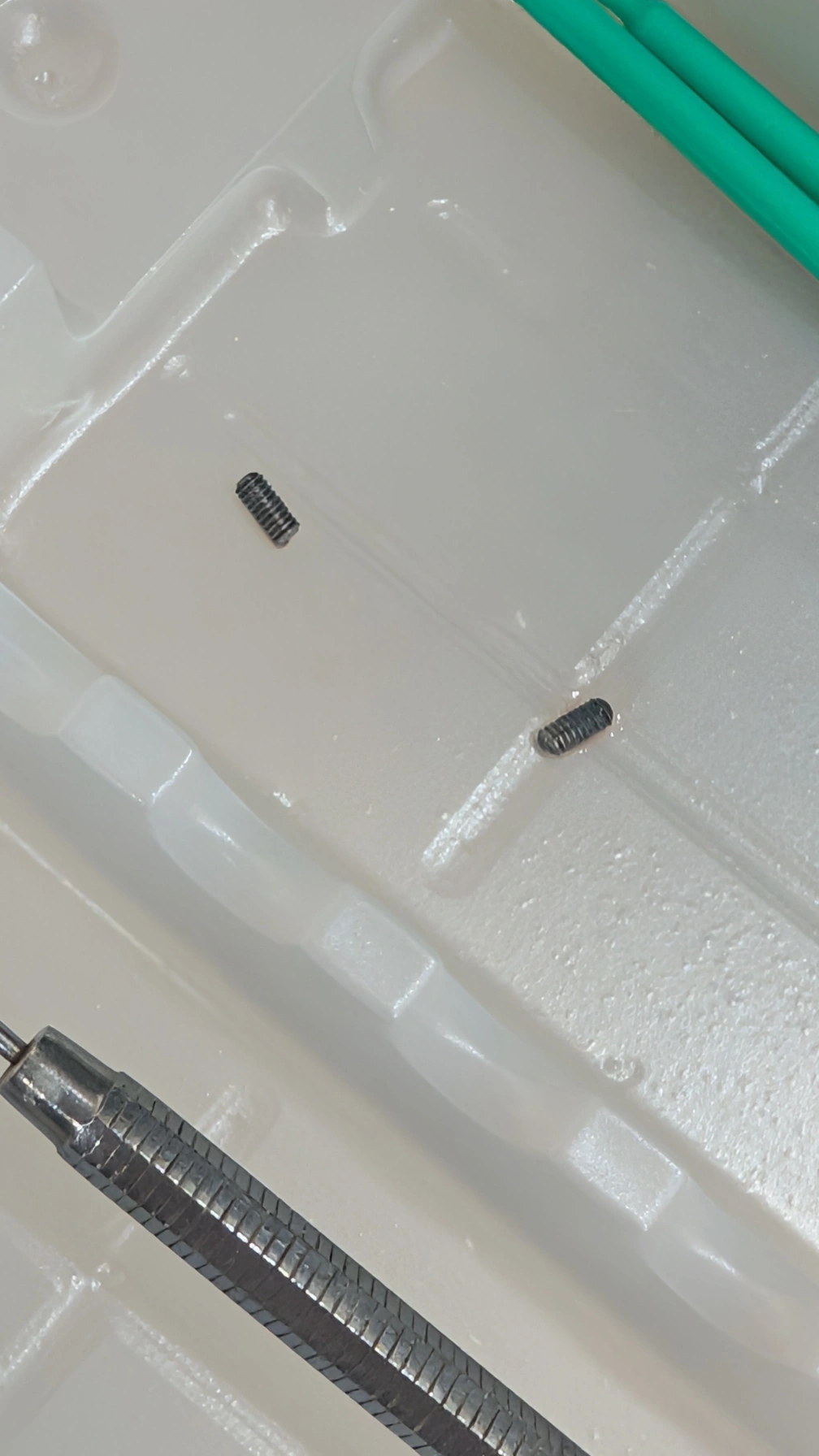
Clinical explanation
In some cases, fracture of the abutment screw happens not at the moment of the initial torque, but later and as a secondary event.
This scenario usually occurs when:
the screw has gradually loosened
the crown has developed functional looseness
the patient has, for some time, chewed on the restoration in that state
and finally the screw, under repeated loads, has fractured
Key clinical point
In a situation where the crown has become loose, we know that the screw was already loosened; therefore the remaining screw fragment has not been under high torque pressure, and this makes its removal usually less challenging.
In this case, the cause of the fracture was not excessive initial torque; therefore a phenomenon like cold welding between the screw and the fixture has not occurred.
The clinical consequence of this type of fracture
For this reason, removing the remaining screw fragment usually:
does not involve a heavy technical challenge
does not require special tools or complex kits
and, unlike fractures caused by over-torque,
is not accompanied by severe binding inside the fixture
️ The technique in practice
In these conditions, what matters most is:
adequate access
sufficient magnification
good lighting
After providing these, one can, using simple tools such as:
an excavator
or even a suitable explorer
gently rotate the remaining screw fragment against the tightening direction and remove it from inside the fixture.
Clinical summary
Not all abutment screw fractures are equivalent.
Recognizing the failure mechanism (gradual loosening versus initial over-torque) directly determines whether we are facing a real crisis or a problem that is manageable in the clinic.
The content of this page is intended for the educational use of dentists and dental students.