
Insight 30 — Checking the Sprue Site in Premill Abutments When the Implant Crown Does Not Fully Seat
Published:
Last reviewed:
فارسی
Clinical explanation
-
In Premill abutments made with CAD/CAM systems, there are usually two methods of attaching the piece to the machine for milling.
- The first method is Reverse Jig. In this method the abutment is attached to a special holder from the connection part and is milled without any additional attachment. For this reason, after milling nothing remains to be cut off or corrected.
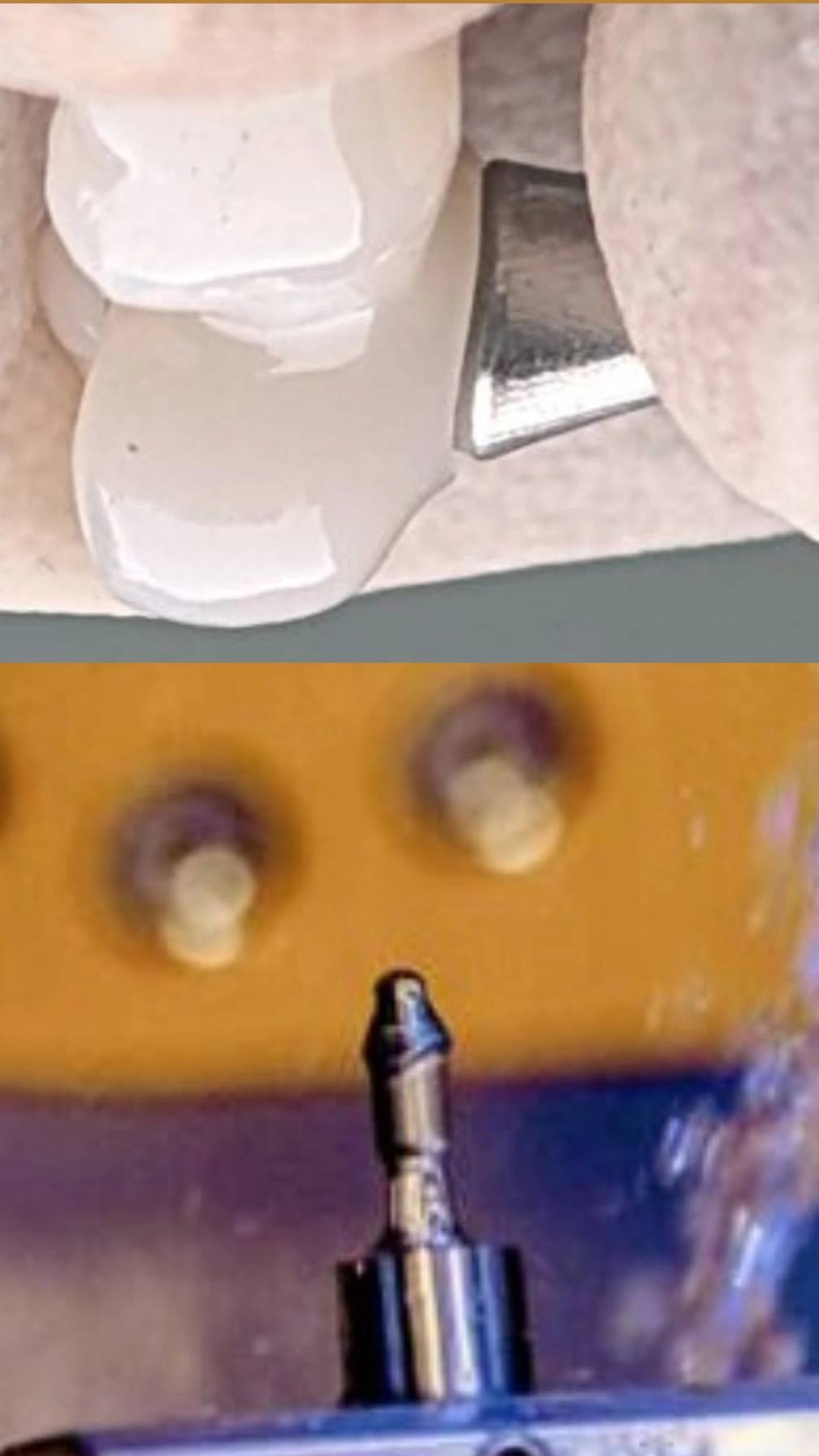
- The second method, which is more common, is the conventional method with a Sprue. In this case, during fabrication of the abutment a small connection called a sprue is created between the abutment and the holder piece so that the piece stays in place during milling. After milling is finished, this connection must be cut off and its site made completely smooth.
- The important point is that if the sprue connection site is not made completely smooth and clean, even a very small protrusion can prevent the crown from fully seating on the abutment.
- In one clinical case I encountered an implant crown that did not fully seat on the abutment, and a gap was seen in the margin area. After examination it became clear that the sprue connection site on the abutment had not been made completely smooth and a very small amount of it remained. This small protrusion had prevented the crown from seating completely on the abutment.
- Therefore, in cases where an implant crown does not seat well on a Premill abutment, in addition to checking the design and the internal space of the crown, one of the things that is better to check is the smoothness of the sprue connection site on the abutment.
The content of this page is intended for the educational use of dentists and dental students.