
Insight 32 — Concave Contour in a Ceramic Crown
Published:
Last reviewed:
فارسی
Clinical explanation
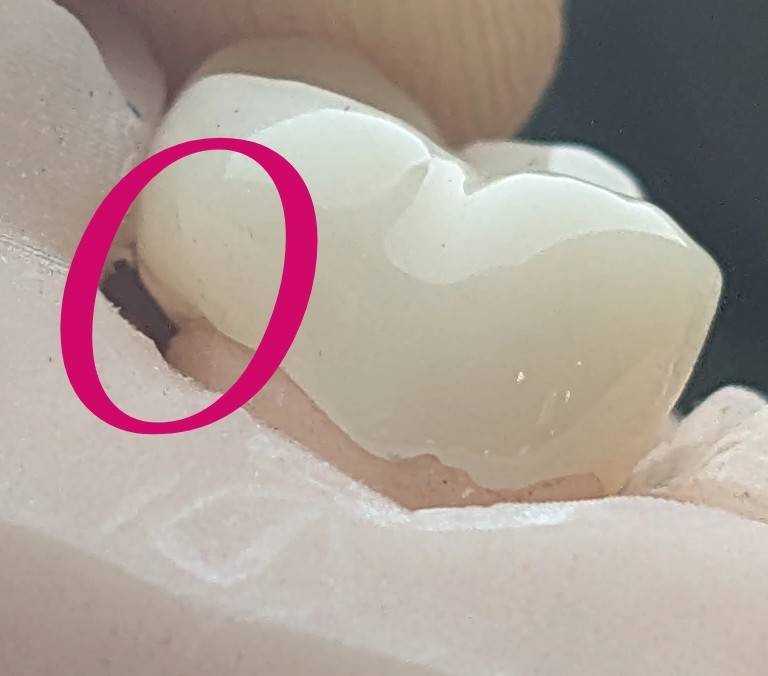
- In examining a ceramic crown that had been sent from the laboratory, in addition to the fact that on the printed cast the location of the margins did not match correctly, in the marked area of the crown surface and in the embrasure the contour had been designed as concave.
- In correct crown design, especially in areas of contact with soft tissue and in the embrasures, the contour should usually be convex or at least smooth.
- Creating a concave surface in these areas can cause plaque accumulation and retention of food, and make hygiene control difficult for the patient.
- For this reason, one of the important steps in evaluating the laboratory's work is careful inspection of the crown contour before delivery to the patient.
- Even if the margin is acceptable, an improper contour can, in the long term, cause gingival inflammation and periodontal problems.
- In this case, due to the presence of a concave contour in the area of concern as well as a problem in the fit of the margins on the cast, the crown was returned to the laboratory for correction and remaking.
The content of this page is intended for the educational use of dentists and dental students.