
Insight 35 — An Abutment Looking Short in the Mouth; Distinguishing an Orientation Error from a Height Error
Published:
Last reviewed:
فارسی
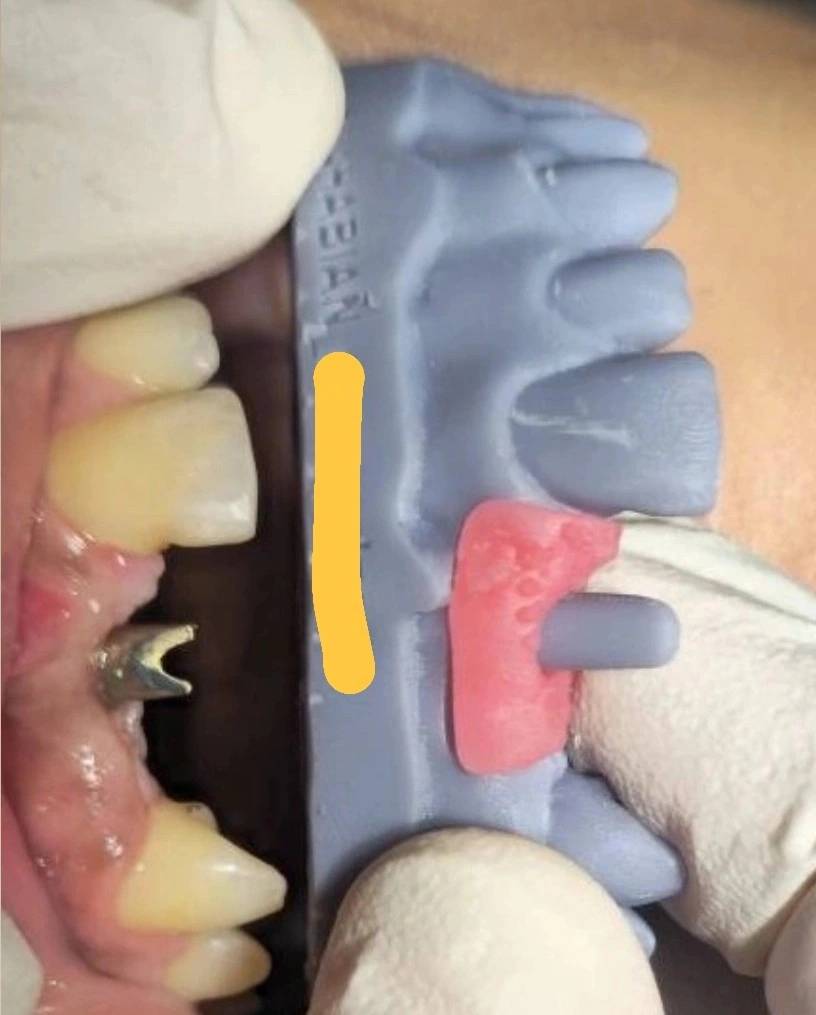
Clinical explanation
- In this case, we have a printed cast with the printed abutment on it, and against it a milled abutment that has been fastened in the mouth. Comparing with the adjacent teeth, it is seen that the abutment in the mouth is simply shorter and its amount of exposure is less.
- The angle and rotation of the abutment in the mouth match the printed version. That is, in terms of spatial position (orientation) no difference is seen. This observation helps us distinguish between two types of error:
- If the error is in fastening the scan body or in selecting the library (Data Error): the difference will not be only in height; usually the abutment in the mouth shows a difference in angle or rotation relative to the actual teeth and is not aligned with its position on the cast.
- But if only the height is less and the orientation is exactly the same: the likelihood of a spatial (angle/rotation) error decreases and one should think more about a problem in transferring or fabricating the vertical dimension.
-
Two probable scenarios:
- 1. Lab Processing Error — in the milling or finishing stage, for example when removing the sprue, part of the abutment height has been unintentionally reduced.
- 2. Error in interpreting the vertical dimension of the scan body — the technician correctly identified the type of scan body (so the orientation is correct), but the reference height of the scan body was not correctly transferred or interpreted and the abutment was made short.
- Key point: when the orientation and rotation are correct but the abutment is seen as shorter, the problem is most likely in the vertical dimension (fabrication or interpretation of height); not in fastening the scan body or selecting the library in terms of orientation. This distinction prevents needless repetition of the scan and makes the path of correction more precise.
The content of this page is intended for the educational use of dentists and dental students.