
Insight 38 — Establishing a Fixed Reference in Combined Implant + Orthodontic Cases: Solving the Equation by Removing Degrees of Freedom
Published:
Last reviewed:
فارسی
Clinical explanation
- In cases where both implant and orthodontics are involved at the same time, one of the main challenges is the multiplicity of unknowns and the absence of a clear reference for decision-making. If the order of solving is not clear, the treatment enters a cycle of unstable corrections.
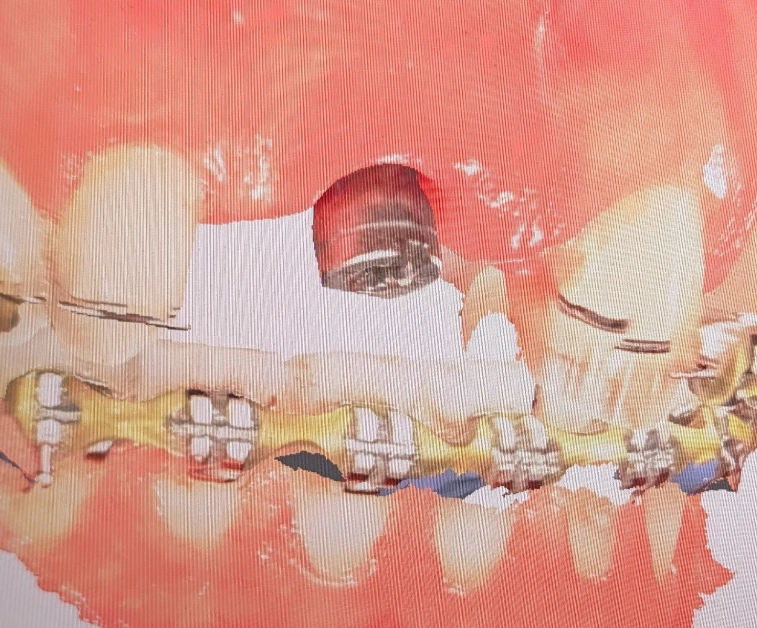
- In this patient, the central tooth has been replaced with an implant and the dimensions of the anterior teeth are smaller than normal. As a result, the orthodontist does not have a clear reference for adjusting the spaces.
- The key point here is: the implant is the only immovable component in this equation and must be chosen as the treatment reference.
- On this basis, using a digital scan, a PMMA provisional crown with the normal dimensions of a central was designed for the implant; not merely as a replacement, but as a three-dimensional guide in the arch.
-
In designing this reference, two principles were observed:
- 1. Correct placement in the arch form (Arch Form)
- 2. Exact matching of the prosthetic midline with the patient's actual midline — because the implant cannot be moved, any error at this stage is transmitted to the whole treatment.
- After fixing this reference, the patient was referred to the restorative specialist so that, with a composite veneer, only the dimensions of the teeth would be normalized, without closing the spaces. This allows orthodontics to adjust the spaces based on the actual dimensions, not on guesswork.
- If needed, the PMMA crown, as a modifiable structure, can be ground or modified with composite by the restorative specialist, without losing its reference role.
-
The logic of solving this case was stepwise:
first remove the implant's degree of freedom ← then define the dental dimensions ← and finally adjust the spaces by orthodontics based on definitive data - Key point: in interdisciplinary treatments, if there is an unchangeable component, it must be turned into the reference. Early definition of this reference takes the treatment out of a guessing state and guides it onto a predictable path.
Establishing a stable reference in the presence of an implant; starting from the immovable component
The content of this page is intended for the educational use of dentists and dental students.