
Insight 40 — Managing Bleeding Before the Scan: a Prerequisite for Accurate Margin Recording
Published:
Last reviewed:
فارسی
Clinical explanation
Stabilizing the field before digital recording
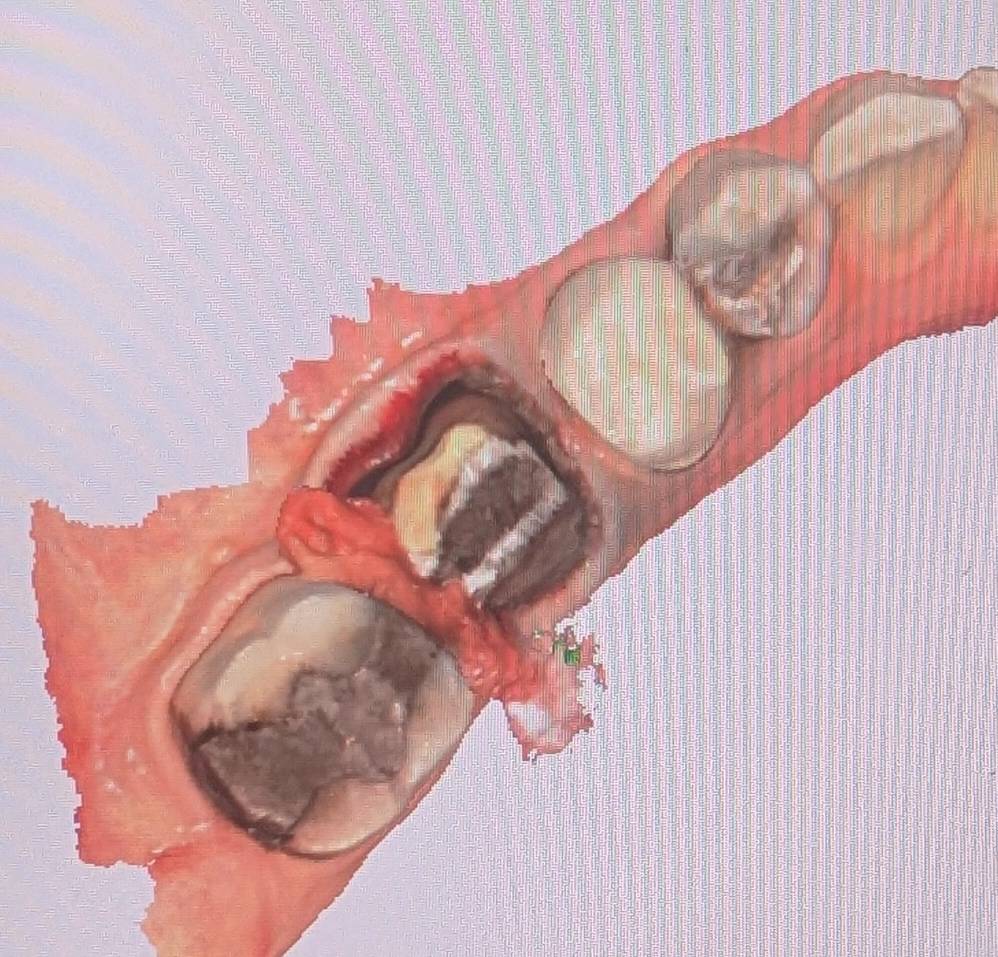
- In intraoral scanning, one of the determining factors in data accuracy is complete control of bleeding in the margin area. The presence of blood can blur the finish-line border and cause errors in the recording and ultimately in the fit of the restoration.
- Ideally, bleeding should be prevented from the outset with controlled preparation and avoidance of unnecessary contact with the gingiva. But in some situations — such as removing overhangs near the gingiva or correcting subgingival margins — this contact is unavoidable.
- In these conditions, bleeding must be controlled before starting the scan. One of the common methods is using gingival retraction pastes. If unavailable, one can use a subgingival cord soaked in a hemostatic agent; but the important point here is that this method alone is usually not sufficient to control bleeding in deep areas.
- In mild bleeding, if the gingival condition allows, one can use something similar to the two-cord or double cord technique; that is, placing two rounds of cord under the gingiva that are soaked in a hemostatic agent. The second cord, by creating gentle, controlled pressure, can help stop the bleeding.
- The important point is that this must be done with tissue judgment. If the gingiva is thin, or we are in an esthetic area, or excessive pressure is applied, this technique can lead to gingival damage or recession.
- In cases where bleeding is deeper or more resistant, the practical solution is using cotton soaked in a hemostatic agent and applying local pressure in the area (in addition to placing the cord).
- To give enough time to this process, the scan can be started from the opposite arch. Then the target tooth is scanned while the cotton is still in place, and the assistant is asked to delete the area of the tooth in question from the data.
- Next, the cotton is removed, the area is rinsed with gentle water pressure, and finally only that area is scanned separately and under bleeding-free conditions.
- Note that with any technique, during the scan the finish line must be scanned by the scanner and must not be under paste, cord, or cotton.
-
Key point:
In intraoral scanning, bleeding control is not just a preliminary step; it is part of the recording process itself. Sometimes, with staged management of the field and local correction of the data, one can achieve an accuracy that is not attainable in a single-stage scan.
The content of this page is intended for the educational use of dentists and dental students.