
Space Creation in a Patient Without a Posterior Stop — From Analysis to Decision
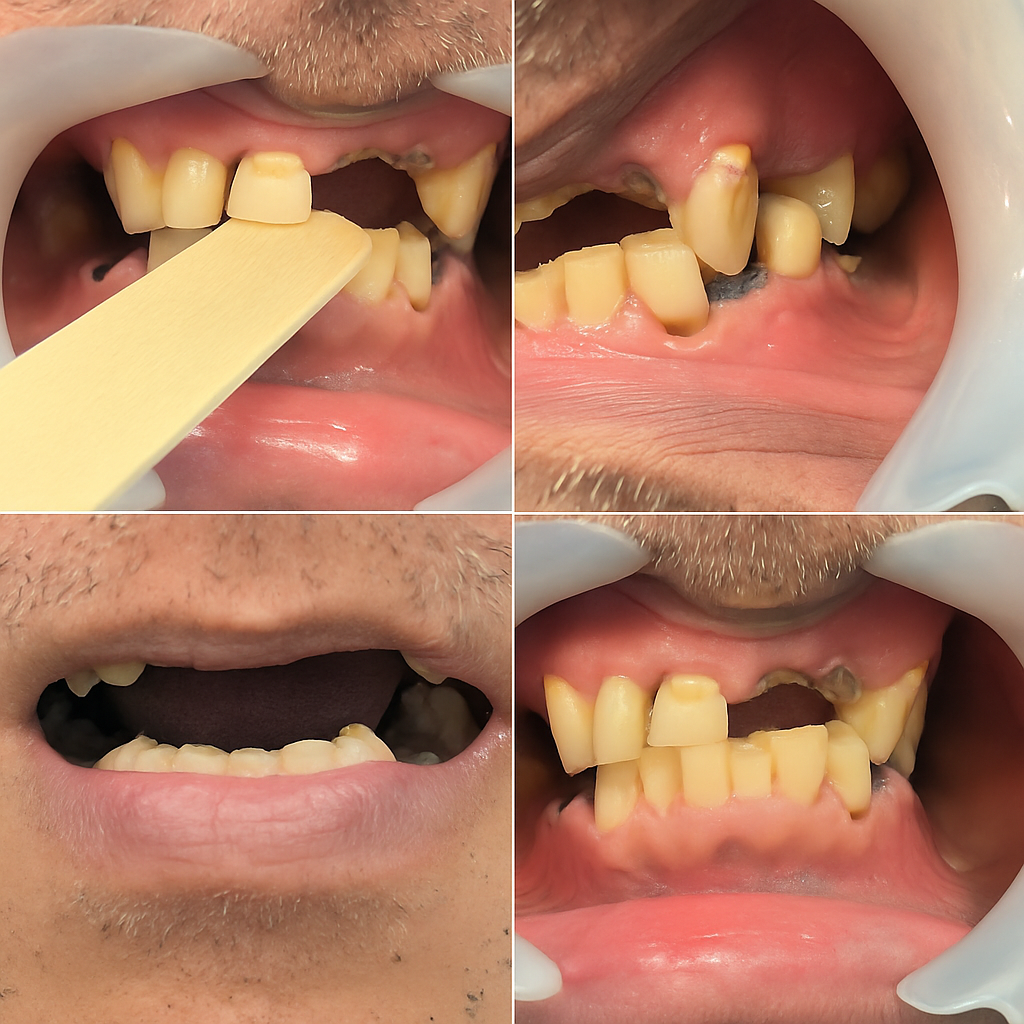
Clinical Insight
The logical process of «space creation» in a patient without a posterior stop — from analysis to decision
When the posterior stop in the occlusal system is lost, a relatively predictable process begins:
- The jaw moves along the closing path without the control of posterior contacts
- The VDO gradually decreases
- The anterior teeth are placed under pressure for years and wear down
- Teeth that have lost their opposing tooth supraerupt
- Ultimately the occlusal plane is disrupted
- and the restorative space becomes limited
In the present case, the entire posterior stop of the system has been lost. Here, «space creation» is a multi-stage, analytical process, not a momentary intervention.
1️⃣ Step one: mental analysis — what happens if the anteriors return to their true length?
In this step, we do not actually lengthen the anteriors.
What we do is imagine that if:
- the anteriors had their true, original length
- and the vertical jaw relationship were at its original value
what would happen to the system?
Assessing the amount of wear of the anteriors is very helpful for estimating the original size; we estimate how much the jaw would have opened if these teeth had not been worn.
This mental analysis has only one goal:
Estimating how much VDO the patient has probably lost.
So this step is a mental simulation — not treatment, not preparation, not tooth reduction. It is merely a diagnostic method for determining the starting point of planning.
After this analysis we understand:
- what the jaw height probably was in the natural state
- how much the anterior and posterior space should be opened
- and what the plane would look like if it returned to its original state
2️⃣ Step two: decision-making — does the correction require collective measures?
Once we have understood how the space should be «in the natural state», it is time to decide:
Does returning to the natural state create enough space?
- If yes → there is no need for a further increase of VDO or surgery.
- If no → we must enter collective corrections:
- Further increase of VDO
- Crown lengthening surgery
- Or a combination of the two
These measures are necessary when the natural space is not enough and the space needs to be opened more than the previously estimated true amount.
3️⃣ Step three: if the natural space is sufficient → entering tooth-by-tooth correction
In this case exactly this happened:
With that same amount of lost VDO, when we assumed the system returned to its natural value, the restorative space opened sufficiently.
So we did not need:
- Further increase of VDO
- Or crown lengthening surgery
any of these.
From this point on, the treatment moves out of the «collective» mode and continues tooth by tooth.
4️⃣ Step four: identifying the culprit teeth — by half-opening the mouth
To determine which teeth must be corrected:
- We place the mouth in a half-open position
- We recall in our mind the correct occlusal plane (what we have learned in removable prosthodontics)
- We compare each tooth with this correct plane
- We see how much and in which direction each tooth deviates from the plane
This method is a suitable tool for identifying:
- The culprit tooth in the disruption of the plane
- And the degree to which each tooth is responsible for limiting the restorative space
Then for each tooth we decide:
- Height correction (Recontouring)
- Structural correction
- Or removal/extraction, if it cannot be brought into the acceptable plane by any correction
In this phase, the treatment turns from a «collective» task into:
Case-by-Case → Tooth-by-Tooth
Final summary
«Space creation» in these types of patients is a three-stage process:
- Mental analysis: if the anteriors had their true length, what would the «original VDO» and the «natural state of the space» look like?
- Macro decision-making: if the natural space is sufficient → we enter tooth-by-tooth correction. If it is not sufficient → we turn to a further increase of VDO or crown lengthening surgery.
- Tooth-by-tooth correction: by half-opening the mouth and comparing the teeth with the correct plane, each tooth is examined and corrected.
The content of this page is intended for the educational use of dentists and dental students.