
Insight 61 — The Cast's Optical Illusion: A Strategy for Adjusting a Single-Unit Central Incisor Crown
Published:
Last reviewed:
فارسی
Clinical Explanation
The single-unit central incisor crown looked short without having been made short; the sloped incisal edge of the adjacent central and the uneven gingival levels of the laterals were creating an optical illusion on the cast — the fix was to have the technician set those landmarks aside and match only the incisal and distal embrasures of the two centrals
This note is about a single-unit central incisor crown that looked short chairside without actually having been made short. What sent the case back and forth between the office and the lab a few times were the landmarks the technician was relying on, on the stone cast, to set the length — none of which were symmetric. What follows: where that optical illusion comes from, and the simple rule I gave the technician over the phone to get past it.
-
Clinical Explanation
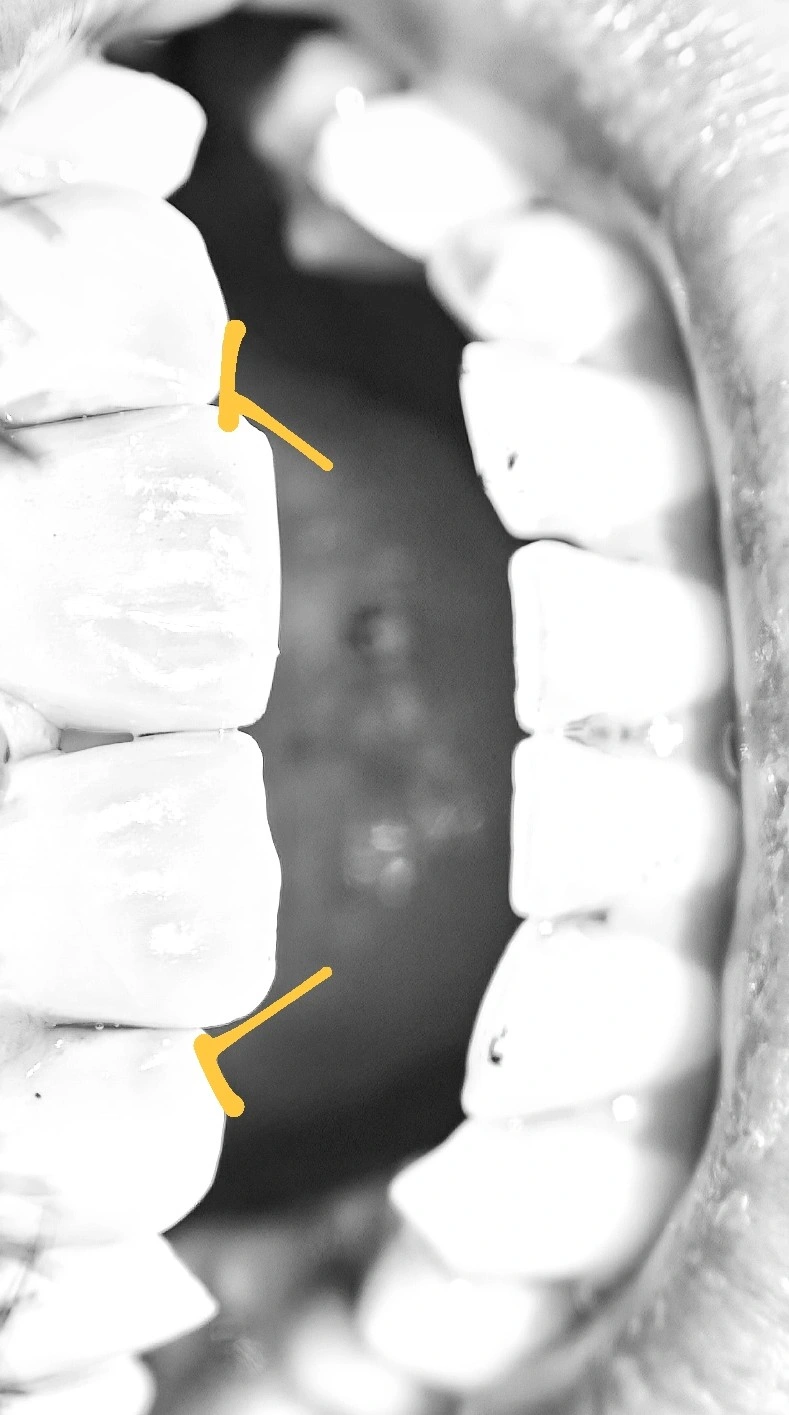
Making a single-unit central incisor crown always has its own particular challenges. In this case, the patient already had a diastema and showed no interest in closing the space. When I explained that the new crown (the left central) would be made slightly wider, they accepted it easily. That extra width isn't the main point of this case, though — I'm mentioning it only to clear up the photo; the real challenge showed up somewhere else. -
The Problem
The lab made the crown, but when I tried it in the patient's mouth, its length looked short against the lip line during speech.
The point here was that the crown as made really wasn't smaller than the right central; rather, the incisal edge of the right central was slightly sloped. That slope, together with one other issue, had made things genuinely complicated: the patient's laterals weren't symmetric either, and their gingival levels differed from one another. When the patient spoke, the incisal edges of the laterals looked perfectly proportionate and even — but that difference in gingival levels created an optical illusion on the cast. -
The Logic Behind the Lab's Error
On a stone cast, the technician sees neither the patient's lip nor the dynamics of the face. On one side they were dealing with the slope of the right central's edge, and on the other, the asymmetry of the laterals' gingiva had confused them. Unaware that the display of the teeth relative to the lip is in fact perfectly even, the technician was trying to set the crown's length from those asymmetric landmarks — and that is what kept making the work short. The case went back and forth between the office and the lab once or twice, but for these same reasons the problem wasn't solved. -
What I Did
In the end I spoke to the technician by phone and laid down one simple rule: "Pay no attention to the size of the laterals or the slope of the adjacent teeth!"
I asked them to put all of their focus on the symmetry of the incisal and distal embrasures of the two centrals relative to each other, and to make them come out perfectly identical. I told them: "Even if the crown feels longer to you on the cast, that's no problem at all — I'll adjust it myself in the mouth." -
In This Case, and the Bottom Line
With that change of approach, the work as a whole came out acceptable and needed only a very minor correction to the mesial embrasure intraorally.
In restorative dentistry, the stone cast is a static environment. Sometimes, to reach a flawless dynamic result (such as harmony with the lip line during speech), we have to disregard the cast's visual deceptions — the slope of an adjacent tooth, or a difference in gingival levels. We shouldn't let peripheral asymmetry pull our focus away from the primary proportion and symmetry of the centrals.
The content of this page is intended for the educational use of dentists and dental students.