
Why Can't This Tooth Be Permanently Restored?
Clinical Insight
Why can't this tooth be permanently restored? And why is an implant the logical, durable, and standard choice?
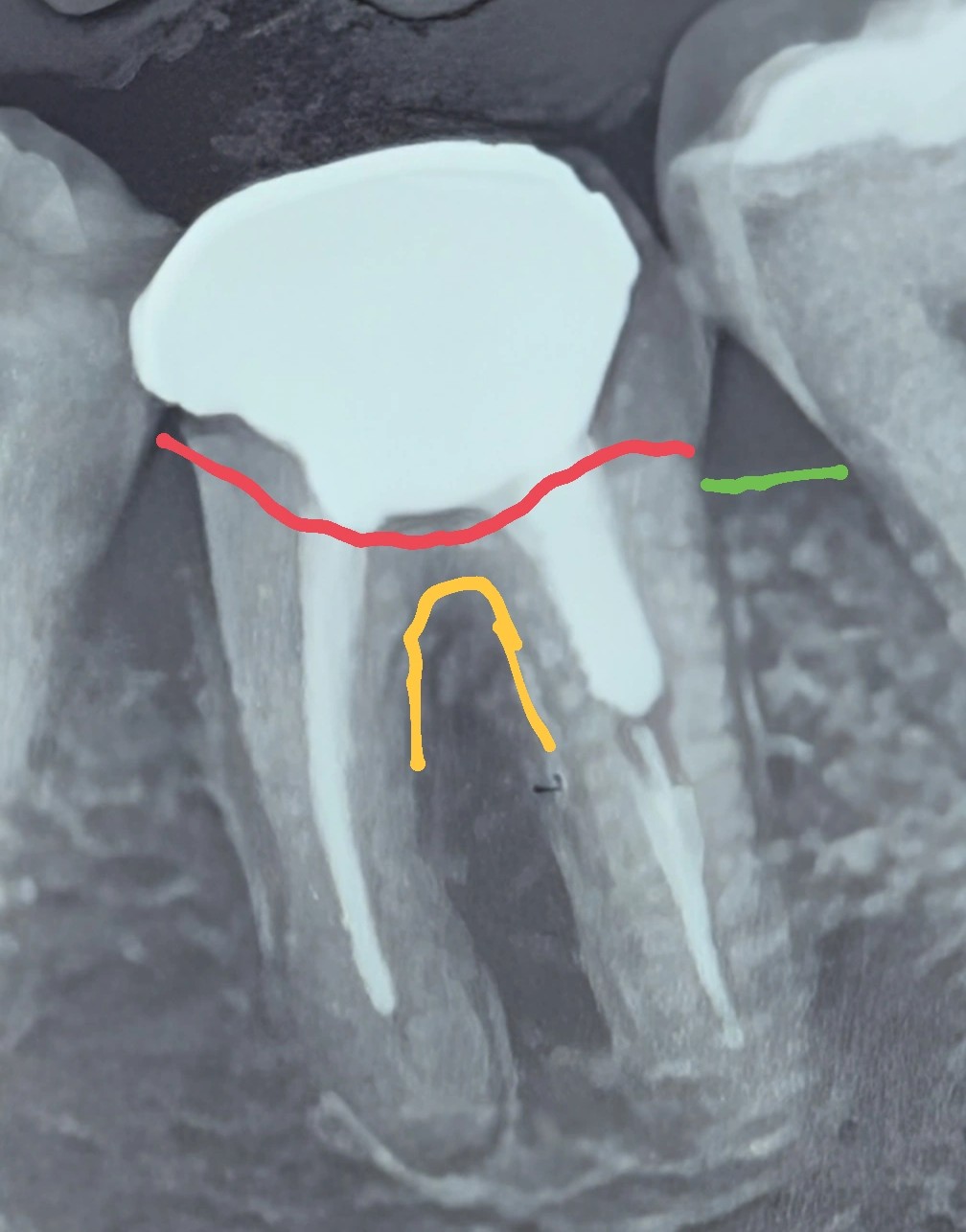
In this case, a lower left molar with extensive structural destruction and root canal problems is seen. Careful radiographic analysis and clinical examination reveal the following:
1️⃣ Radiographic caries always appears less than the reality
The caries margin (red line) in the image indicates extensive destruction, but on the radiograph the true depth and extent of the caries appear less than their real amount.
Clinically, this means:
- Loss of a large part of the coronal structure
- No possibility of creating an adequate ferrule
- Lack of long-term stability of the restoration
2️⃣ The biologic width cannot be provided
According to the green line (bone level), the height of the remaining tissue is not enough to create an adequate biologic width.
The main problem:
Any attempt to create biologic-width space through crown lengthening surgery places us within the furcation region, because of the amount of bone destruction required.
This means:
- Risk of furcation involvement during surgery
- Lasting consequences for periodontal health
- Unpredictability of preserving the tooth in the long term
3️⃣ Surgery of this magnitude increases food impaction in the embrasures
To provide the biologic width, bone and soft-tissue removal is required at a level that:
- opens the embrasures further
- increases food impaction
- makes cleaning the area more difficult
4️⃣ The root canal treatment is incomplete, but even correcting it does not solve the main problem
In the image:
- The canals have not been filled completely and to standard
- Retreatment is needed
But even an ideal RCT does not solve the periodontal–biological–structural problem of this tooth.
5️⃣ The patient is traveling; the treatment must be definitive, predictable, and low-risk
Given that the patient is abroad:
- Staged treatments
- Possible retreatments
- Multi-stage surgeries
- Restorations with a high risk of failure
are not logical options for him.
️ Final summary
Considering:
- Caries deeper than the radiographic extent
- The impossibility of providing biologic width without furcation involvement
- A severe increase in food impaction after surgery
- Incomplete root canal treatment
- The lack of a stable structure for restoration
- The patient's need for a definitive and durable treatment
The best and most standard treatment plan: extraction + implant
This choice:
- gives the most predictable functional result
- prevents furcation and biologic-width problems
- is the lowest-risk choice for the patient
The content of this page is intended for the educational use of dentists and dental students.