
Insight 79 — The Other Side of the Wing: The Detail That Gets Overlooked
Published:
Last reviewed:
فارسی
Clinical Explanation
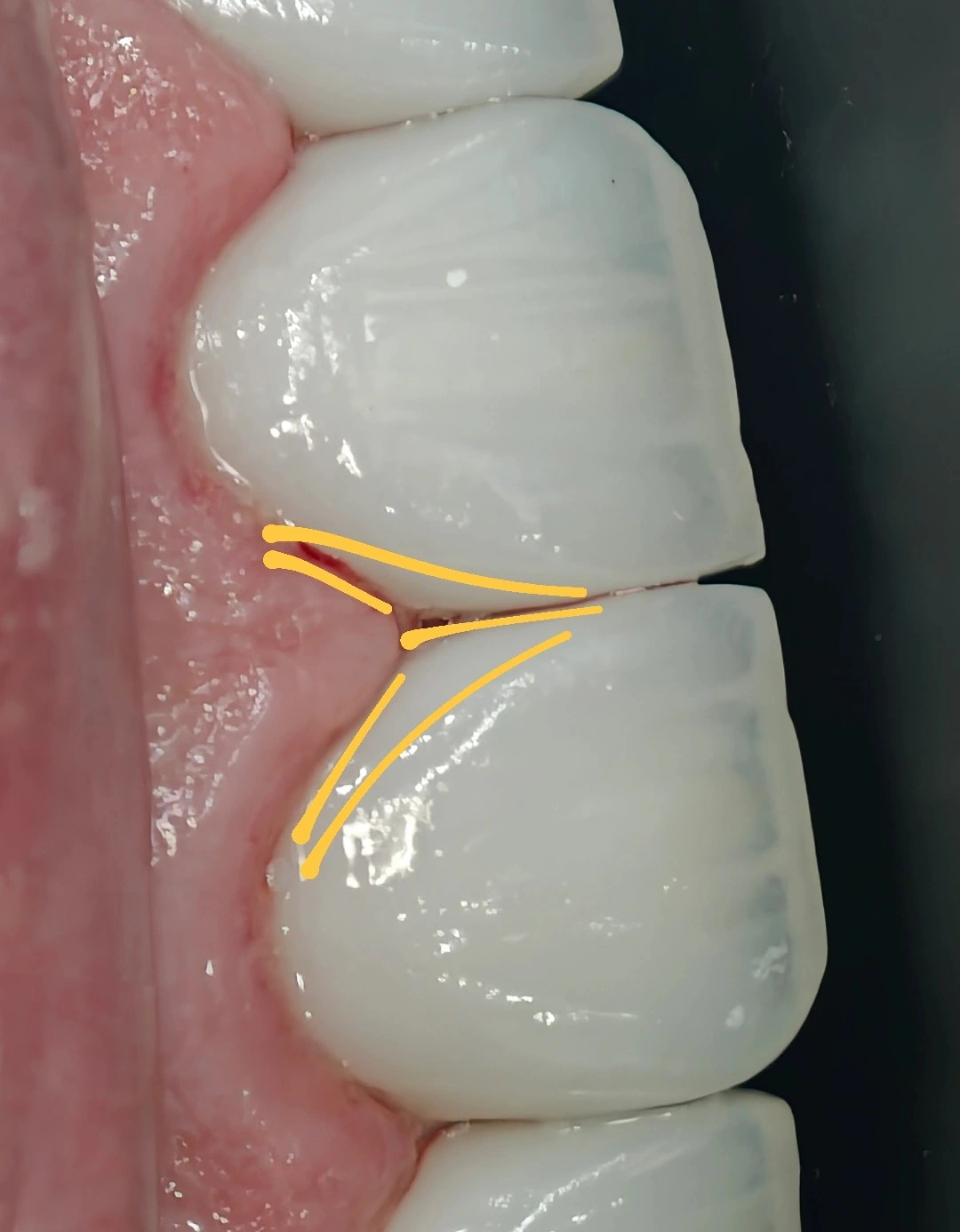
This image is one of my own cases, and I want to use it to explain a point about design. The area I marked with the yellow line is what is called the wing. In the cervical and proximal region the ceramic extends a little further towards the gingiva and the adjacent tooth so that the gingival embrasure becomes narrower and the dark triangle created by gingival recession or by the form of the tooth appears smaller. The technician can work that same area with a slightly heavier stain so that it gains depth and reads like the natural shadow between two teeth. Up to this point, this is what is usually said when the wing is taught.
-
The other side: the lingual aspect
But the real point of this post is what usually goes unsaid: the wing is only seen from the buccal, yet it exists on the lingual side too. If the contact has not been opened and the finish line has stopped on the labial of the contact, the technician has no choice but to build the wing as a separate flap sitting over the papilla. From the front the black triangle is hidden, but behind that same flap, on the lingual side, a concave space remains between the ceramic and the tooth which is not easily cleaned, and the scientific literature describes this very area as a plaque trap and a site prone to caries. In other words, a wing without an opened contact gives esthetics from the buccal and caries from the lingual. -
The rule
So the rule is simple: if we are going to have a wing, the contact must have been opened and the preparation must have been carried through to the lingual of the contact, so that the ceramic can emerge from within the sulcus with a convex, continuous emergence profile and the lingual side remains cleanable. -
The cost of opening the contact
This is where the question of cost begins, because opening the contact is not free and it removes proximal enamel that does not come back. Depending on the circumstances of the case, that cost carries two completely different meanings. Sometimes the contact has already been opened for another reason — as in this case, where proximal caries had taken the contact itself and I only removed the caries. Here the enamel is gone in any event and the embrasure has gone out of control in any event, so there is no room for hesitation, and the wing is in fact compensating for a space the preparation itself created. But sometimes the contact is intact and we want to open it purely for the sake of the wing, and here one has to weigh seriously how much esthetics is gained in exchange for that enamel. When there is no other reason for a veneer at all, direct composite is usually the more rational choice, because it is done without preparation and can be repaired if the gingiva recedes further later on. -
How much of the embrasure to close
There is an important point about the extent of closure as well: the whole embrasure does not have to be closed, and in fact complete closure is the most expensive part of the work. The logic resembles closing a diastema; the further down and the closer to the papilla we want to bring the ceramic contact, the more cervically the ceramic has to emerge from the tooth, and to keep it from becoming overcontoured and ledged there, the preparation has to be deeper in that same area and the margin more subgingival. This is precisely the region where enamel is at its thinnest, and a deeper preparation will almost certainly put the margin on dentin or cementum, and below the gingiva at that, where bonding and moisture control are harder. On the other hand, in large triangles the result of complete closure is a long, unnatural contact that is not necessarily more attractive than the triangle itself. -
Summary
For this reason, a controlled reduction is usually the better choice: we stop at the point where the margin is still on enamel or close to it, the emergence stays convex without extra preparation, and the contact keeps its natural proportion. A triangle made smaller under these conditions is itself a successful outcome, provided the patient has expected exactly that from the outset.
The content of this page is intended for the educational use of dentists and dental students.