
Insight 83 — Case: Two Implants at an Unfavorable Angle to Each Other — How Do We Take the Impression?
Clinical Explanation
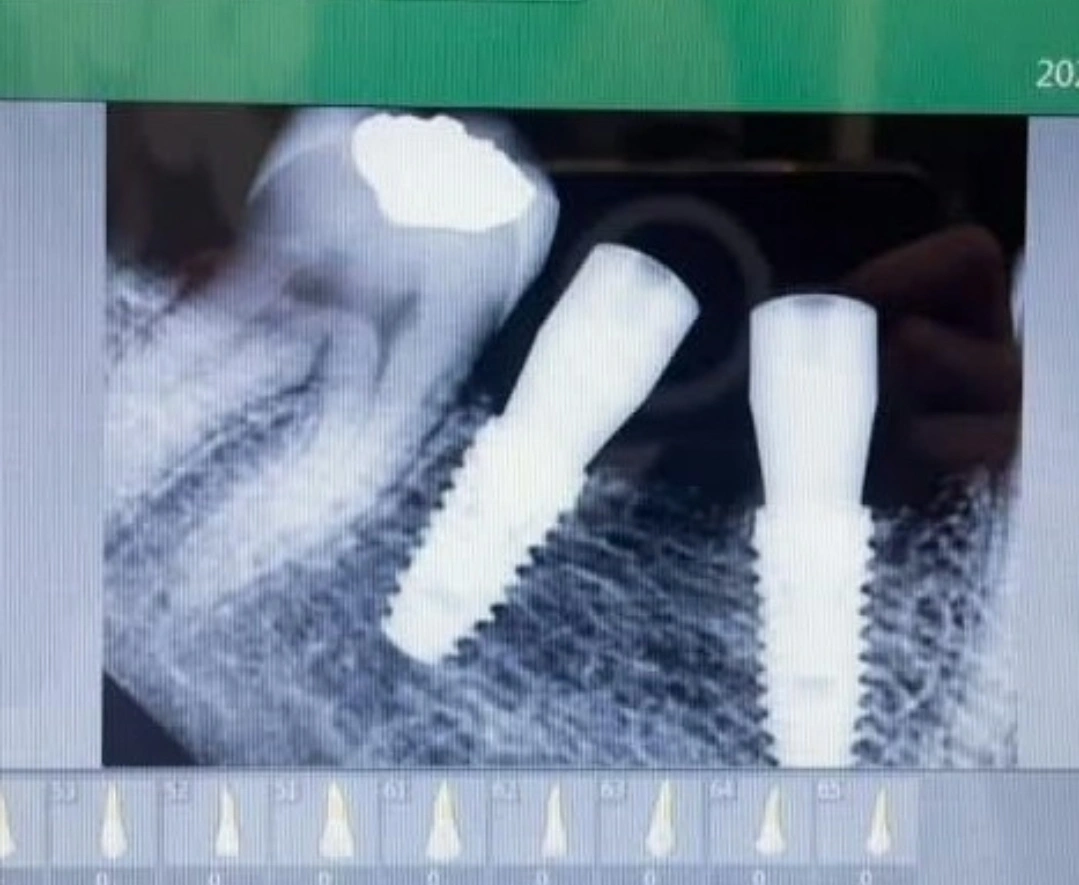
A colleague sent me this radiograph. Two implants have been placed next to each other at an unfavorable angle to one another, and the question was what to do to take an impression of this situation. I am putting the questions asked and the answers I gave here in the same order, because this is a common case and many people will probably run into it.
One point before anything else: look at the natural tooth behind the implants. This tooth is tilted, and if it interferes with the path of insertion of the restorations, it has to be corrected first. Whichever method we choose, this step has its own place.
Question: I don't have a scanner and I want to take an impression. I started last night, but because of the angle of the implants I couldn't seat and tighten both impression copings at the same time; in the end I got tired and the work was left unfinished. What should I do?
First take an impression of the implant with the bad angle so that its abutment can be made. Then tighten that abutment in the mouth and place an impression coping on the second implant. Splint the abutment to the impression coping with resin. After splinting, loosen the abutment screw, because once we take an open tray impression we no longer have access to the abutment and its screw, and the abutment has to come out inside the impression together with the impression coping. Now take the impression with the open tray technique. This is done only so that the laboratory has a reference for making the second abutment. In the end, make the restorations separately from each other.
Question: Can't I take a separate impression of each implant, and then have the laboratory scan them and bring both onto one cast?
You can. Take a separate impression of each one and have the laboratory make the abutment and framework for each separately. Then tighten the abutments in the mouth, place the frameworks, and take a pick-up impression. The only thing is that the laboratory must make the abutments against the right reference, because if their angles differ a lot, the paths of insertion and removal of the restorations will also differ a lot, and cementing them becomes difficult.
What is the main difference between these two methods, and when should we choose which?
First let's make one thing clear: these restorations are not connected to each other and are going to be made separately, so exact parallelism of the abutments is not a requirement. What we want is for them to be as parallel as possible, because the work becomes easier and cleaner and single crowns seat next to each other more easily. If the paths of insertion and removal of the two restorations interfere with each other a lot, seating them next to each other becomes troublesome.
From here on, the main point is whether or not the laboratory has a reference for the orientation of the abutments relative to each other.
If we take a separate impression of each implant but the laboratory does not know the angle of the two abutments relative to each other, each is made on its own and their paths of insertion may interfere with each other. So if there is a reference for this relationship, you can take a separate impression of each, go as far as the framework stage, and then take a pick-up impression.
But if the angle is truly problematic, the safer route is to have the abutment of one of the implants made first, tightened in the mouth, and then have an impression taken of it together with the second implant. This way the laboratory has the exact angle of the first abutment and makes the second abutment in harmony with it.
In the end, there are many creative ways; these two were only examples, meant to help with thinking differently.
The content of this page is intended for the educational use of dentists and dental students.