
Three Spaces That Determine Where a Restoration Sits: The Neutral Zone, the Envelope of Motion, and the Envelope of Function
Every restoration is placed into a space that already existed, and three concepts define that space.
∆ The Neutral Zone
Teeth sit in a region where the tongue pushes from the inside and the lips and cheeks push from the outside. The neutral zone is the region in which those two forces cancel each other out. Its position is not defined by any fixed anatomic landmark, it differs from one person to the next, and it shifts with age and with changes in muscle tone. Older sources also give it other names, such as the dead zone or the zone of equilibrium.
The concept is defined in the literature for complete dentures, where moving outside this region relates directly to denture instability, impaired speech, poor facial tissue support, and a restricted space for the tongue. In fixed work the prosthesis does not move, but the physiologic principle is the same: the buccal and lingual contours are part of the wall of the space in which the tongue and the cheek do their work.
∆ The Envelope of Motion
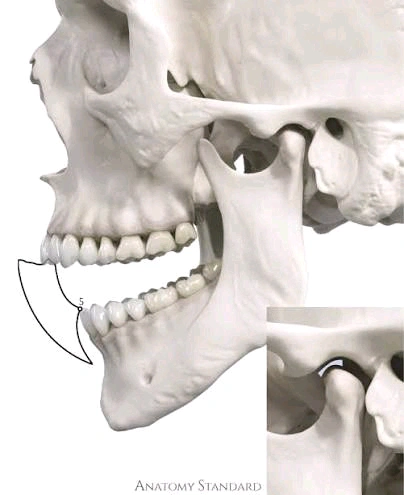
Imagine you have marked a point on the incisal edge of a lower central incisor and you are looking at the patient from the side. Now you ask the patient to take the jaw to its extreme limit in every possible direction: open the mouth fully, bring the jaw forward from the closed position as far as it will go, take it back as far as it will go, and, with the teeth sliding on one another, move from the closed position forward and downward. The path that point travels through space encloses a bounded region. This is the well-known Posselt diagram.
The posterior and inferior borders of this region are determined by the joint, the ligaments, and the muscles — things we cannot change. The superior border, however, is built by the tooth contacts, which is precisely what we build with our restorations.
∆ The Envelope of Function
Take the same point, but this time the patient does nothing except chew, drink, and speak. Here the point no longer travels to the borders of that region; it follows a smaller, repeating path close to the upper part of that same volume. This ordinary, everyday path is the envelope of function.
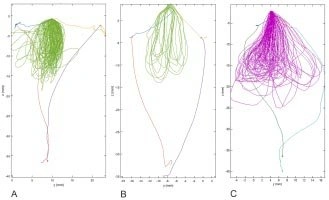
This one relates to the palatal contour of the maxillary anteriors, the length of the incisal edge, the anterior guidance, and the occlusal anatomy. If the work encroaches on this path, the patient meets it with every ordinary chewing stroke, and the result appears later as wear, chipping, debonding, loosening, and sometimes muscular discomfort. Its severe form is what is known as a constricted chewing pattern.
∆ A Practical Note
Every time we lengthen a canine, take the incisal edge longer or shorter, or change the palatal inclination of the anteriors, we are changing the patient's envelope of function. This is sometimes necessary, but it has to be done knowingly, and we have to know what new path the patient is going to adapt to. The provisional stage, and building a temporary, exists for exactly this: so that the change is tested before the definitive work.
∆ Summary
The neutral zone governs the buccolingual position, and the envelope of function governs the form of the occlusal surface and the guidance. Both are spaces the muscles and the movement of the jaw have already built, and the restoration is meant to be placed inside them, not to redefine them heedlessly.