
Retrofit Post and Core
Sometimes a patient's crown is sound and acceptable, but it has come off the tooth together with the core inside it, or, after preparation, the coronal part of the tooth has fractured while the provisional crown was being removed. In this situation, instead of making a new crown, a new post and core can be made that fits exactly inside that same old crown.
∆ When can this method be used?
This only makes sense when both the crown and the tooth meet certain conditions. The crown must have no problem in appearance, contact with the neighboring teeth, or bite, or its problem must be correctable. The tooth margins must be intact and still sit precisely under the crown margin, and about 2 mm of coronal tooth structure must remain. If the tooth needs endodontic retreatment, it must be done in a way that does not lose the margins or the height of the walls.
∆ Steps
To begin, the canal is prepared for a prefabricated post, and the outer length of the post is chosen so that it does not prevent the crown from seating fully. Then undercuts are made in the pulp chamber and around the post so the composite has mechanical retention. A light-cured posterior composite is chosen in a shade that differs from the tooth, so that excess composite on the margins is easy to see. The inside of the crown is also coated with bonding agent so the composite does not stick to it.
The core is built in layers. Each time, a small amount of composite is placed and the crown is tried in to make sure it seats completely and no composite has been pushed over the margins; then the crown is removed and the composite is cured. This is repeated until the core has enough retention and resistance. If the crown does not seat fully somewhere, the core is trimmed with a bur at that moment and the work continues.
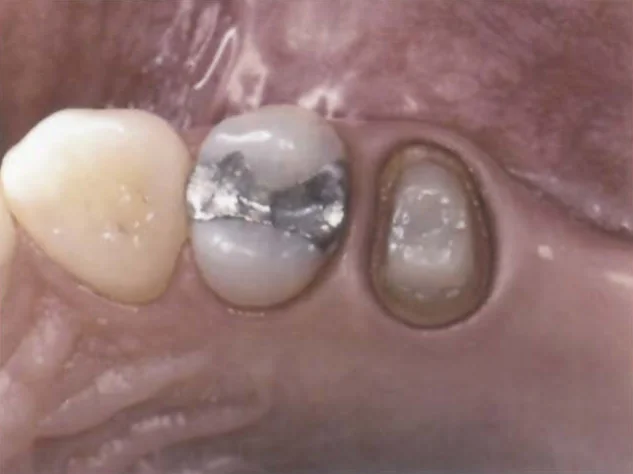
Finally, the bonding agent is removed from inside the crown, the inside of the crown is sandblasted, and the crown is cemented.
∆ The cast version and its problem
Instead of this method, the post-and-core pattern can be made directly in the mouth so that it fits both the canal and the crown, and then cast. But this method is harder and more technique-sensitive, because a pattern that was accurate in the mouth may no longer have the same fit with the tooth and the crown after casting, and getting a metal piece to the same accuracy is not easy.