
Chairside 14
A Composite Veneer Request in Periodontally Compromised Teeth — a Diagnostic Clue, Not a Treatment Answer
-
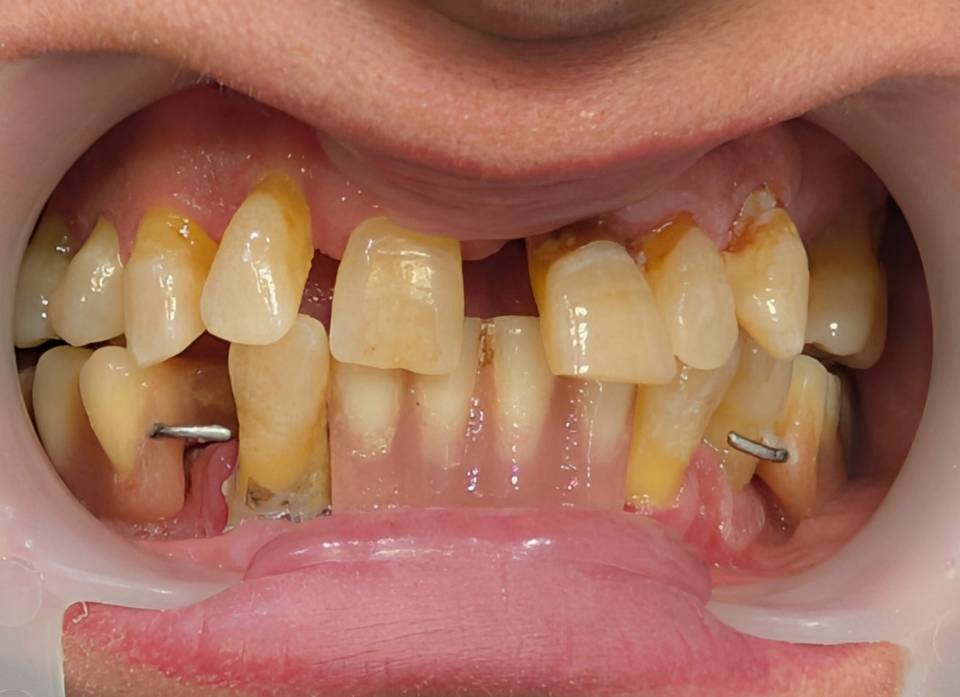
The patient had presented with a chief complaint about the appearance of the maxillary anterior teeth.
On initial assessment, the condition of the lower jaw was such that an overdenture treatment plan was considered for it.
-
In the upper jaw, a number of teeth were maintainable with advanced periodontal treatment,
but this «maintainability» did not mean «esthetic restorability».
-
The patient's question was simple but meaningful:
«Can't these be made beautiful with a composite veneer?»
This very question was the starting point of the case analysis.
-
In the clinical evaluation, there were several decisive points:
The teeth were proclined and protruded,
the periodontal support was reduced,
and the oral ecosystem was in a fragile state.
-
In such conditions, a composite veneer not only does not correct the problem of profile and position,
but, by adding volume and creating overcontour,
makes plaque control more difficult and increases the risk of inflammation and further breakdown.
-
In other words,
we are adding a layer of esthetics to a system that is biologically unstable.
-
Even if a veneer can technically be done,
the main question is not «Can it be done?»
but rather:
«What does this request show us about the case?»
-
In this case, the answer was clear.
The patient's request for a composite veneer,
more than being a solution,
was a diagnostic clue —
a clue to the mismatch between esthetic expectations and the biological and positional limitations of the teeth.
-
On this basis,
analysis of the combination of factors — from the periodontal status and the bone-loss pattern to the dental position and long-term prognosis —
led us away from limited restorative approaches,
toward a full reconstruction decision.
The final decision
was full extraction and implant-based reconstruction.
-
This case is a reminder:
Patients' esthetic requests should not be seen merely as a «proposed treatment» —
sometimes these very requests
are our most important diagnostic data.
The content of this page is intended for the educational use of dentists and dental students.