
Chairside 43
Should We Fill the Excess Space with Another Tooth or Move It?
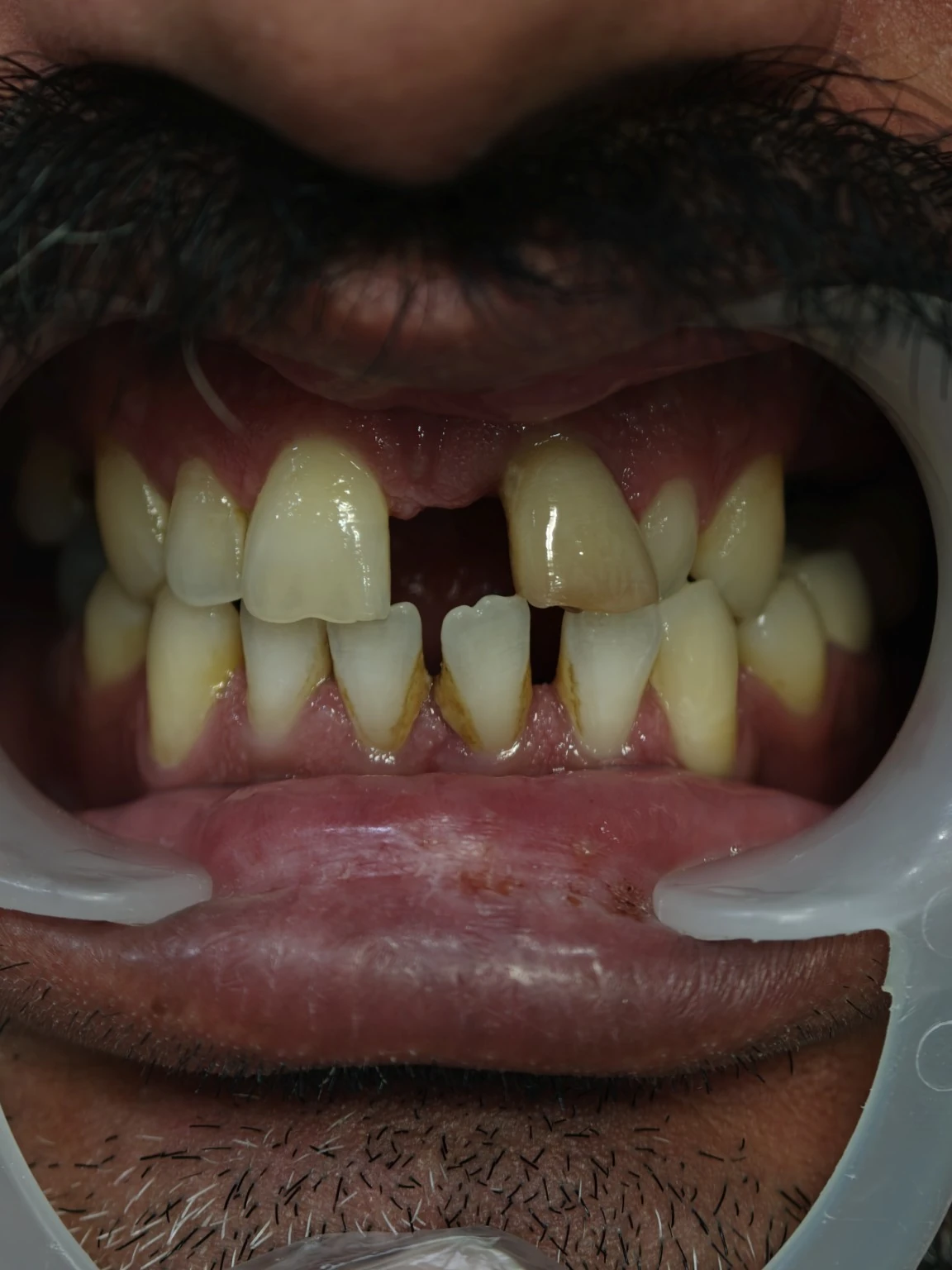
Today, a patient came in for a consultation about an implant to replace the maxillary left central incisor. The tooth had not yet been extracted, but it was to be replaced with an implant. The left central incisor had migrated markedly distally, the lateral incisor on the same side was very small, and there was a large diastema between the central incisors.
The first thing I did was assess the midline. Using the philtrum of the upper lip as a reference, I realized that placing the implant-supported central incisor crown directly next to the right central incisor, without a gap, would shift the dental midline by about two millimeters or more.
With the teeth at their current widths, we therefore had to retain some diastema to achieve the desired midline.
I explained to the patient that, if he wanted no space between the central incisors, we could increase the width of the right central incisor by adding composite. But he did not want that tooth to be wider. I therefore explained that he would need to accept some space between the central incisors in the final plan.
The next question was what to do with the rest of the excess space.
The patient himself suggested that perhaps, in addition to the implant-supported central incisor, we could make another small tooth resembling a lateral incisor alongside the existing lateral incisor to fill the entire space.
That suggestion was worth considering initially. For me, the main issue was not the biomechanical problems of a small cantilever; the question was whether there was enough space to create such a tooth with suitable dimensions and esthetic proportions.
I could have scanned the patient and asked the laboratory to determine the dimensions and positions of the teeth through digital design. But that would take time and impose a cost on the patient. For the initial decision, I tried to clarify the space situation with a simple mental analysis.
The key point was that all the excess space was currently concentrated mesial to the left central incisor. The distal surface of that tooth was in contact with the small adjacent lateral incisor.
But the implant crown did not necessarily have to occupy the current position of the central incisor crown. By replacing this tooth and designing the crown in an appropriate position, we could transfer some of the existing space to the distal side of the new central incisor.
To make this easier to understand, imagine that all the excess space is money collected in one bag, which we need to divide among several people.
First, we have to set aside the share for the midline diastema, because the patient does not want the opposite central incisor to be wider.
Then we look at how much space remains. Is that enough to make another small tooth resembling a lateral incisor?
With this mental calculation, I realized that, after setting aside the share for the diastema, there would not be suitable space for an additional tooth. The new tooth would probably be too small to have acceptable esthetic proportions.
At that point I wondered: why make an additional tooth at all?
We already have a small lateral incisor whose width we can increase to use up some of this awkward amount of space.
Even with that approach, however, a small amount of excess space would probably remain.
The next solution was to change the location of that space rather than try to fill it where it was.
If the orthodontist could move the left lateral incisor slightly mesially, the remaining space would move to its distal side. In that position, we could compensate for the gap by slightly increasing the width of the canine.
In this way, instead of making an additional tooth, we would redistribute the available space among the teeth through a combination of appropriate positioning of the implant crown, widening the lateral incisor, orthodontic movement, and reshaping the canine.
I ultimately decided to refer the patient for an orthodontic consultation first, to establish whether such limited movement, for example with an aligner, would be feasible. Once that is clear, we can plan the final implant position and restoration dimensions more precisely.
For me, the point of this case was the value of a simple mental analysis during the initial consultation.
I did not need to take a scan and carry out a digital design at the outset to recognize that making an additional tooth was probably not a suitable solution.
We had a fixed amount of excess space, all of which was concentrated in one place. We first set aside the share for the necessary diastema, then recognized that the remaining space was unsuitable for an independent tooth. We could use some of it by widening the lateral incisor, and consider orthodontic movement for the remainder.
This mental analysis does not replace precise planning before treatment, but it helped me choose a more logical direction for continuing treatment without imposing an additional cost at the first appointment.
Sometimes the question is not how to fill excess space; it is where to locate that space so that filling it becomes easier and the result more esthetic.
This page is intended for educational use by dentists and dental students.