
Chairside 44
When Occlusal Assessment Changed the Treatment Path
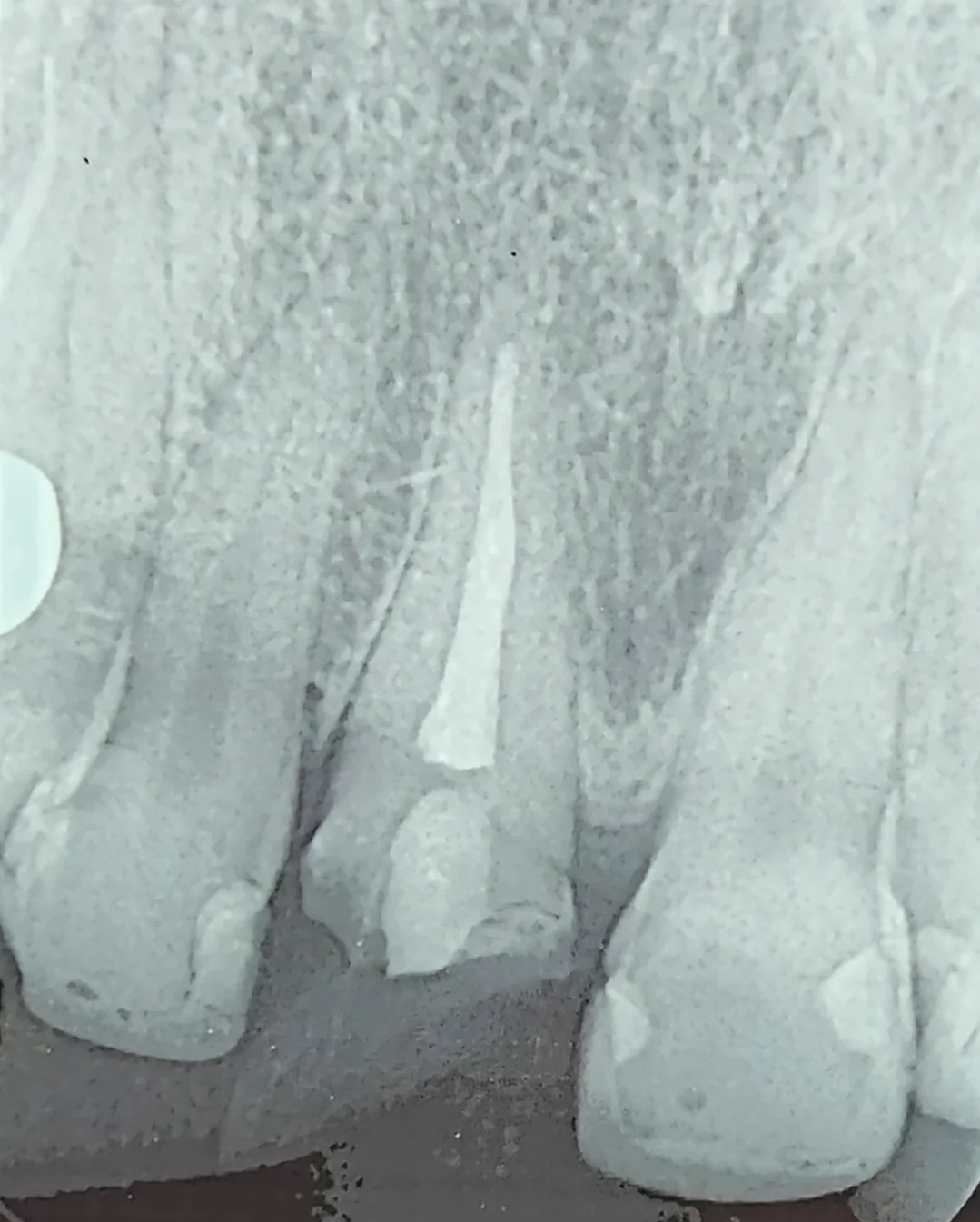
The patient presented with a crown fracture of a maxillary central incisor. On the radiograph, the root was not particularly long, and a substantial part of the crown had been lost.
Before choosing a treatment, the tooth's prognosis had to be established. If it could be restored with an acceptable prognosis, preserving the tooth took priority; otherwise, replacement with an implant was the alternative.
For a more accurate assessment, the caries was removed to determine how much sound tooth structure remained and which walls were thin or unreliable.
After this step, the only wall that could be relied on to provide a ferrule was the palatal wall.
In maxillary anterior teeth, the palatal wall is one of the most important walls for providing a ferrule, because of the direction of functional forces.
Up to this point I was still thinking of preserving the tooth, but before finalizing the treatment plan I decided to examine the patient's occlusion as well.
The patient had a deep bite.
In a deep bite, the horizontal component of the force applied to the maxillary anterior teeth is greater.
Had this tooth had sufficient walls, the deep bite alone would not have been a reason to extract it. Here, however, only the palatal wall remained, and relying on a single wall under a greater horizontal force lowered the prognosis of the restoration too much.
In the end, because of the insufficient remaining tooth structure, and taking the occlusal conditions into account, I decided to replace the tooth with an implant instead of restoring it.
The point of this case: when the remaining tooth structure is borderline, the occlusal assessment can change the final choice of treatment.
This page is intended for educational use by dentists and dental students.