
Chairside 45
When the Incisal Edge Discrepancy Between Two Central Incisors Gave Away a History of Trauma
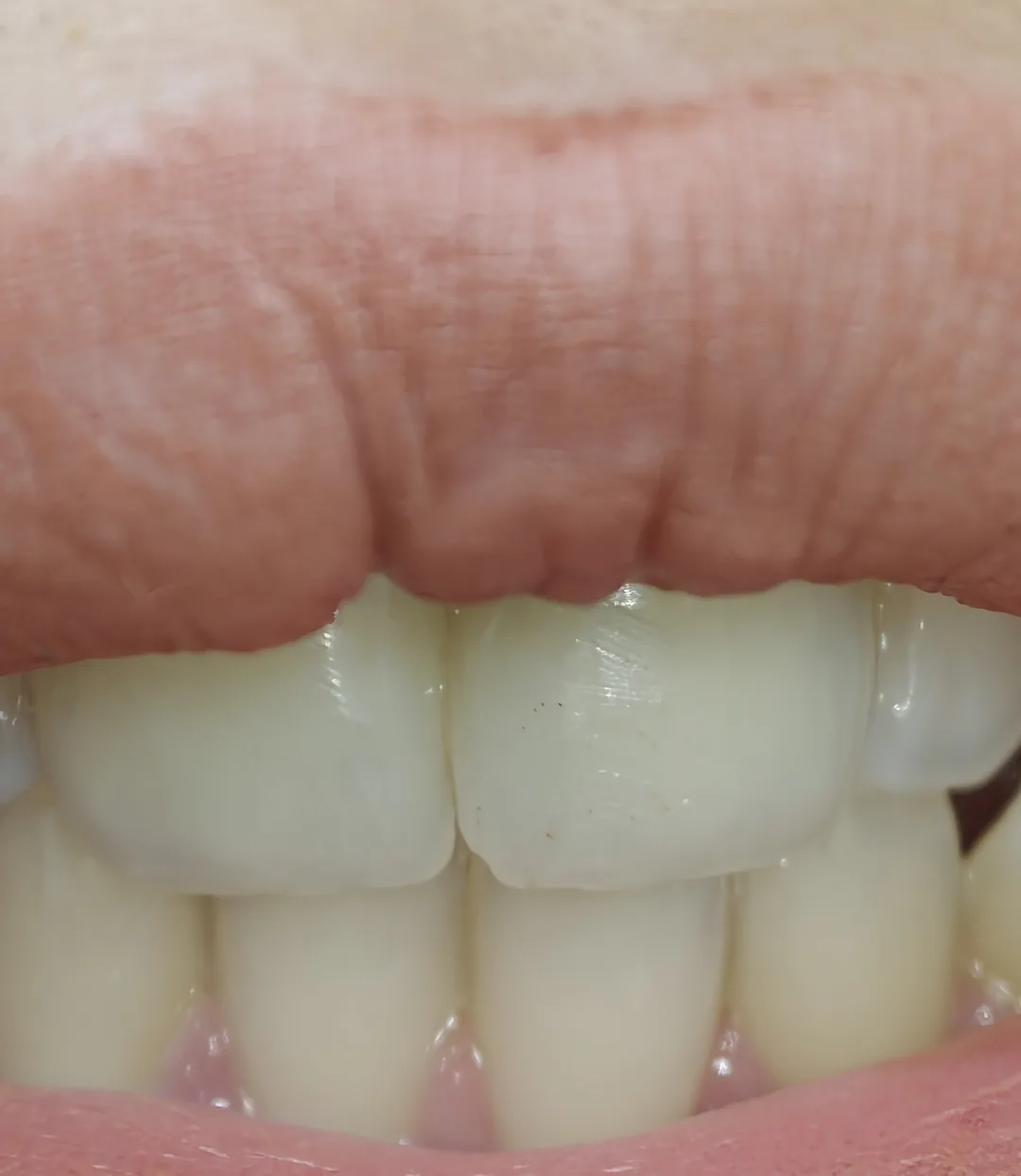
A few years ago, I had placed a laminate veneer on this patient’s maxillary right central incisor and a crown on the maxillary left central incisor.
The patient came in for a visit and said they felt that the edge of the upper right central incisor, the tooth with the veneer, had come down compared with before.
I had not yet opened the previous record. Seeing the difference in level between the incisal edges of the two central incisors, two possibilities came to mind: either the left central incisor was on an implant, or it was a natural tooth that had become ankylosed after trauma.
I asked the patient: “Is the crown on the upper left central incisor on an implant?” They said no, it was their own tooth.
I said: “Then this tooth was probably injured at some point.” They said yes!
That answer strengthened my suspicion of ankylosis of the upper left central incisor.
In ankylosis, part of the root surface fuses with the bone and the tooth starts to behave like an implant. That is, it can no longer move along with gradual dentoalveolar changes the way the adjacent natural teeth do.
These changes do not stop when growth ends and may continue even in adulthood; especially in the anterior maxilla, differences in tooth position can become esthetically visible.
I explained to the patient that if the edges of the two central incisors were level at the time the treatment was delivered and now differ, that does not necessarily mean the veneer has come down. The right central incisor may have moved along with the natural teeth, while the left central incisor, because of possible ankylosis, has lagged behind that movement.
Of course, confirming ankylosis requires clinical and radiographic examination and comparison with previous records.
What I found interesting about this visit was that, without seeing the record, simply by observing the difference in level between the incisal edges and considering two possibilities, I was able to predict a history of trauma to one of the teeth; a history the patient also confirmed.
Sometimes a seemingly simple discrepancy between two restorations hands us a clue to the patient’s dental history.
This page is intended for educational use by dentists and dental students.