
Chairside 05
The Post Bent — Right Where There Is No Ferrule
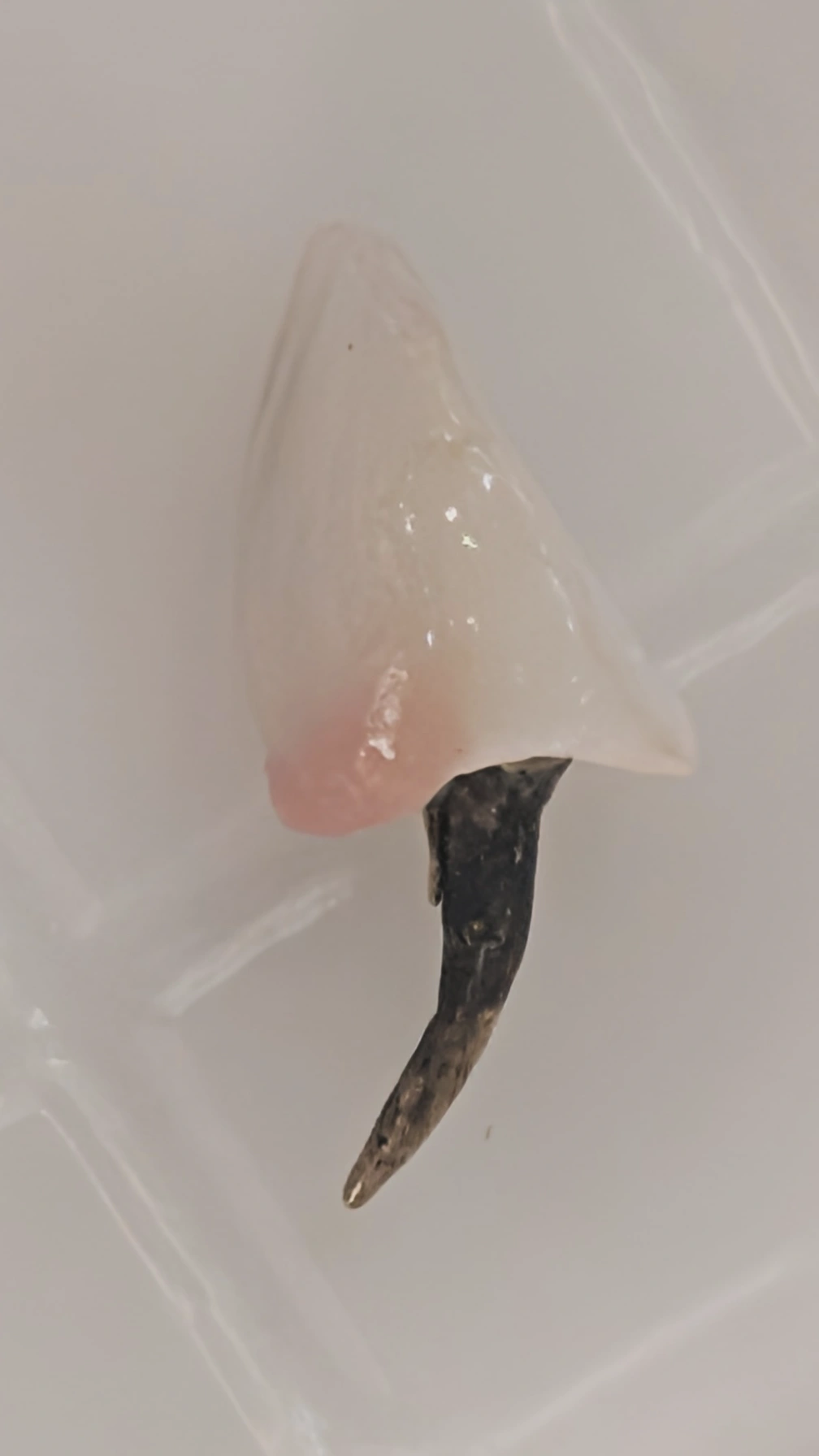
The patient presented with a dislodged crown. The crown had come out of the canal together with the post. The post was made of NPG — and it had bent.
At first glance, one can think of various factors: the length of the post, the thickness of the post, the quality of the cement, or the occlusal forces. But the main sign was elsewhere.
A post that bends is usually bearing a force that should fundamentally not be transferred to it. In a tooth that has a proper ferrule, the functional forces are distributed in the remaining dentinal walls of the crown, and the post plays more the role of retaining the core than that of a load-bearing pillar.
When there is no ferrule, this balance is lost. The force is transferred directly to the post, and the structure enters the failure phase.
The form of this failure can vary. In this case, the post has bent. But if the post material had been harder and less deformable, the root would probably have fractured instead of the post bending.
In fact, bending of the post and fracture of the root are two sides of one problem: the absence of a ferrule.
In the final analysis, two scenarios are possible:
- Either there was insufficient ferrule from the start and the treatment plan was inappropriate and incorrect
- Or, over time and probably due to recurrent caries, the coronal structure and the ferrule were lost
Asking when the previous treatment was done can help in understanding this path. However, at this stage, knowing it usually does not change the fate of the treatment. And the tooth does not have a good prognosis.
Chairside, sometimes a bent post clearly shows where the problem began.
The content of this page is intended for the educational use of dentists and dental students.