
Insight 101 — Gingival Level Difference Between Two Central Incisors: Making a Crown Look Shorter with Line Angles
In this patient, the right central incisor needed a crown, but the gingival levels of the two central incisors differed considerably. The gingiva of the right central incisor had receded, and its clinical crown was clearly longer than that of the left central incisor, which was the patient's own natural tooth. To evaluate the final form, I asked the laboratory for a pattern resin, and the laboratory sent a pattern made of printed resin that was essentially flat and without form. It had no defined line angles and no contour from which a decision about the final shape of the crown could be made, and on this pattern the difference in length between the two central incisors was noticeable at first glance.
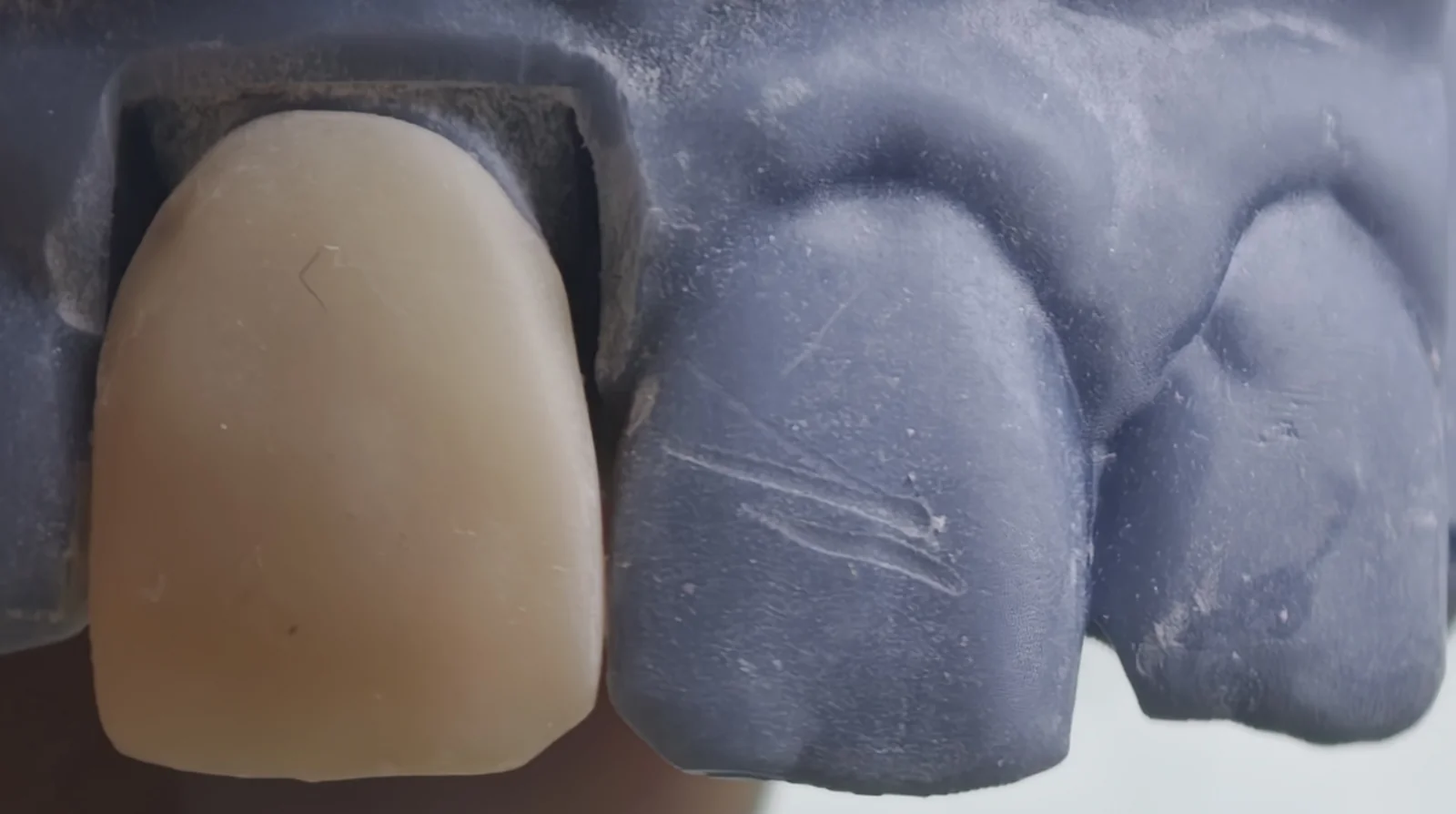
If the final crown is also made in the same way, that is, with a flat labial surface and no defined line angles, the whole crown from the incisal edge to the gingiva is seen as one continuous surface, and the eye reads this entire length as tooth. The result is what was seen on the pattern, that is, a central incisor that is clearly longer than the central incisor on the opposite side.
What I asked the laboratory to do was to mirror the labial surface of the left central incisor and place it on the right central incisor like a mirror image. The key point is the position of the line angles. The line angles of the right central incisor crown must be designed to coincide exactly with the line angles of the left central incisor, and because the left central incisor is shorter, this design ends at a distance from the gingiva in the cervical area. The area that remains between the end of this design and the gingiva, that is, outside the boundary of the line angles, is given a different contour and is shaped like a short exposed root. A stain with a higher chroma is usually also applied to this area to make it look more like a root surface.
As a result, the actual width and height of the crown do not change, but the viewer's eye judges the length of the tooth by the surface lying between the line angles. When this surface is the same in the two central incisors, the two teeth look the same size, and the cervical area is read more as an exposed root than as a continuation of the crown. This is an optical illusion and does not eliminate the difference in gingival level, but it makes the difference between the two central incisors less noticeable.
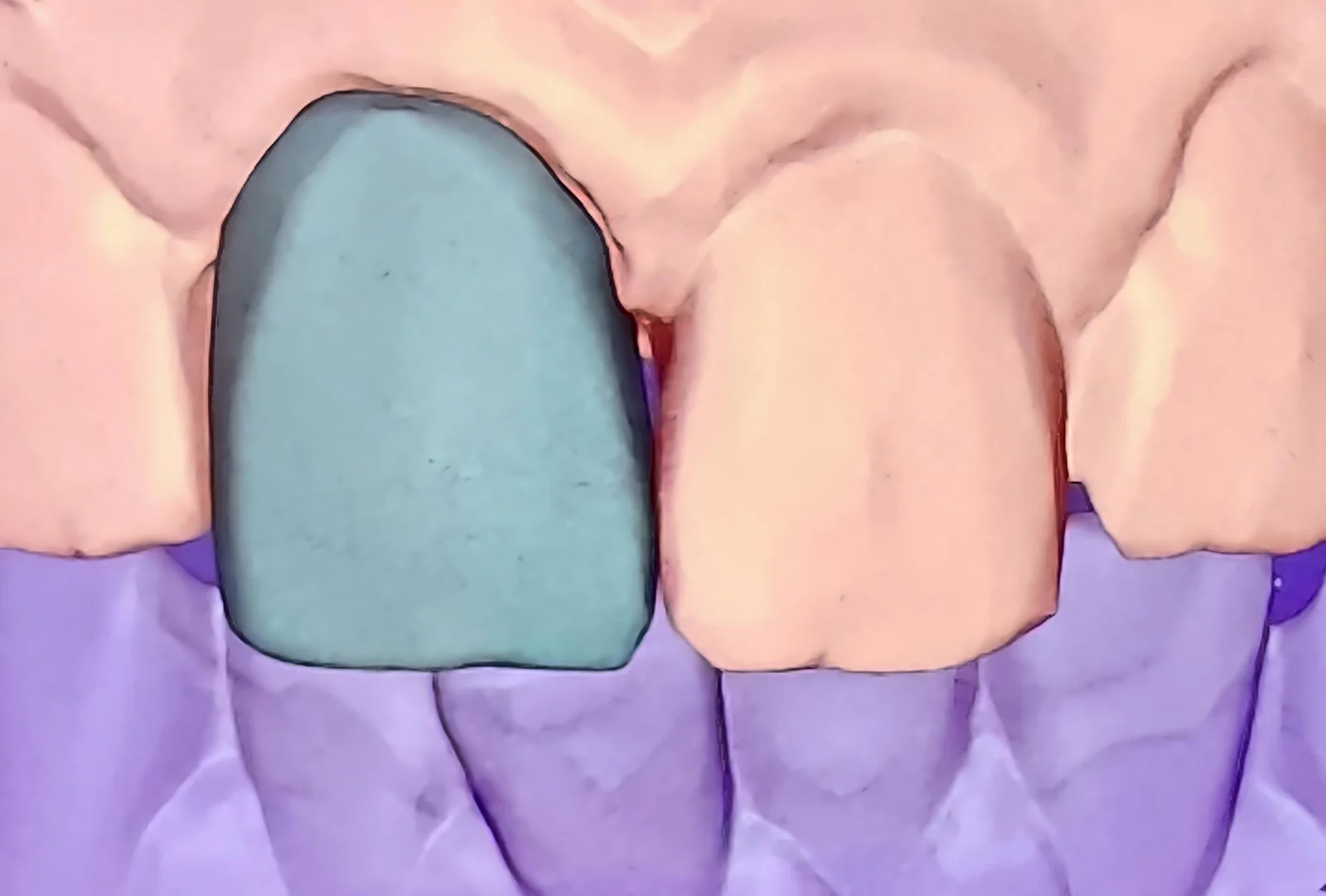
In this design too, the line angles of the right central incisor crown were still not completely similar to those of the left central incisor. I asked the laboratory to bring the line angles closer together so that the surface between them would be exactly like that of the left central incisor, because the whole effect of this method depends on this match.
This page is intended for educational use by dentists and dental students.