
Insight — Vague Pain and the Boundaries of Responsibility in Treatment
Clinical Insight
«Pain» is not always where the patient points; and «immediate treatment» is not always the best favor to the patient.
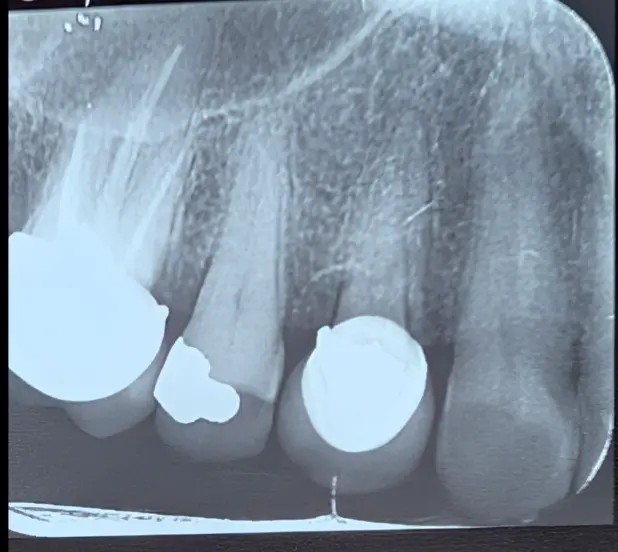
In this case, the patient presented complaining of severe pain in the upper right side. The patient — and even the appearance of the teeth (severe wear of tooth 5) — pointed the finger of blame at the second premolar, but the truth was something else.
The main challenge of this case had two layers:
- Precise differential diagnosis
- Legal management of a patient who has a «fresh» crown
1️⃣ Escaping the trap of visual diagnosis with endodontic tests
At first glance, tooth 5, because of its heavy wear, seemed the main candidate for the pain, and the patient also pointed exactly to that area.
But relying on appearance is deceptive. In addition to taking a careful history, performing endodontic tests (Endodontic Tests) was the key to solving the puzzle.
The test results showed that tooth 5, despite its wear, has no pulpal problem, and the main cause of the pain is tooth 4, which had recently been crowned.
Key point: in severe pain, the phenomenon of «referred pain» can mislead both the patient and the dentist. Only precise endodontic tests can distinguish the true culprit from the neighboring teeth.
2️⃣ Crisis management and the legal protocol
The treatment plan was clear: removing the crown, root canal treatment, and a new prosthesis.
But the main challenge was this: the patient was extremely distressed, insisted that the work be done that very moment, and had no desire at all to return to the previous clinician.
Why, despite the patient's insistence, did I hold back? Because the crown had been «freshly» placed.
- We do not know exactly what is going on under that crown (the amount and manner of preparation, the state of the ferrule, a possible perforation, etc.).
- The flaws of the previous work are not apparent until the crown is removed.
- If we remove the crown, any flaw beneath it (even if it is not our work) may be attributed to us.
3️⃣ Self-Protection Strategy
My personal and professional caution in these matters is clear:
To prevent legal issues (Medico-legal), «at least the step of removing the fresh crown» should be performed by the previous clinician.
This has two benefits:
- Responsibility for the state of the prepared tooth becomes clear.
- The patient comes to us with the real condition of the tooth (without the crown), and our treatment plan will be based on «what we see», not «what we guess».
️ Final summary of the case
When facing a patient who is in pain and has received a new crown:
- Do not be fooled by the patient's pointing or the appearance of the neighboring teeth; vitality tests are mandatory.
- Haste to help a distressed patient should not lead you to blindly accept responsibility for an unclear treatment plan.
- Referring to the previous colleague solely to remove the crown is a smart move to clarify the treatment path and prevent legal troubles.
The content of this page is intended for the educational use of dentists and dental students.