
Insight 114 — Why Does a Titanium Bar Break Right Through the Screw Channel?
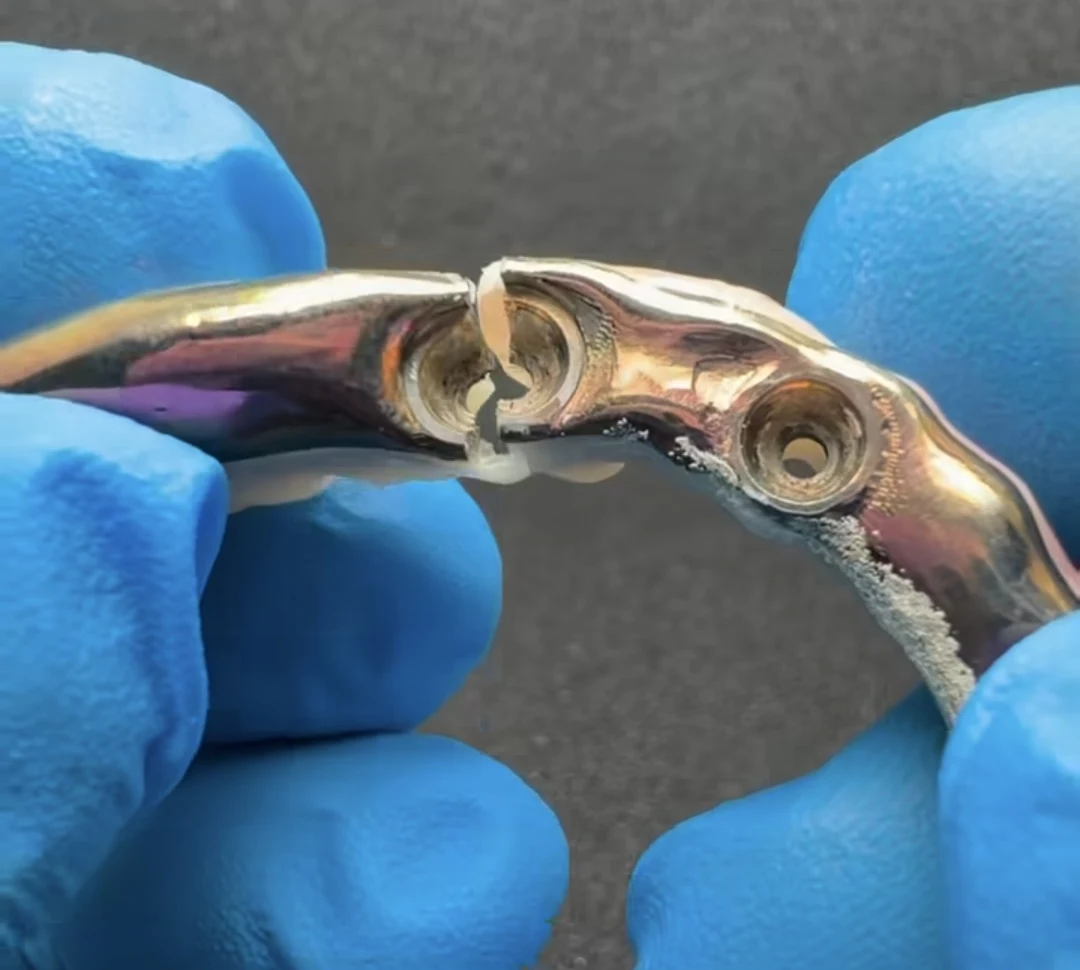
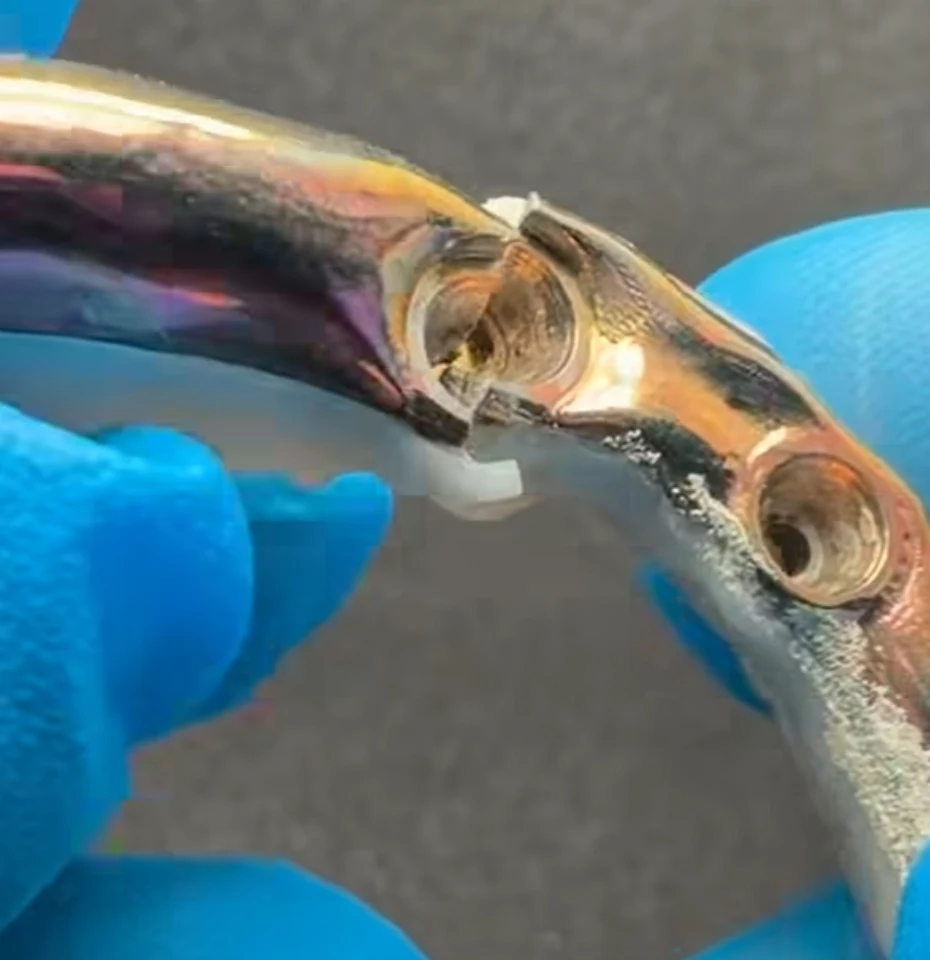
A colleague has published a video in which the titanium bar of an implant-supported full-arch fixed prosthesis has fractured. In this case, the last implant was in the canine region, and the bar continued as a cantilever to teeth 4, 5 and 6. What is interesting is that the bar did not break in the cantilever itself but through the middle of the screw channel of the last abutment. The patient had bruxism and also had an implant-supported fixed prosthesis in the opposing jaw. The video does not allow a definitive cause of the fracture to be stated, but it is possible to examine why this point was at greater risk of fracture than the rest of the bar.
1. The cantilever and the point that takes the greatest load
The force applied to the cantilevered teeth does not simply push the prosthesis downward. It tends to bend the bar around the last implant, like a seesaw whose fulcrum is the last implant. The greater the force or the longer the cantilever, the greater this bending moment. Its maximum is not at the site of chewing but at the fulcrum itself, that is, the last implant. In this case, the three-unit cantilever extending to tooth 6 lengthened this arm. When the bar bends, its occlusal side is stretched (tensile force) and its tissue side is compressed (compressive force). A crack usually starts on the side that is stretched.
2. Why exactly through the screw channel?
The screw channel lies exactly at the point that bears the greatest bending force. This channel removes a large portion of the metal, so the same heavy force has to be borne by less metal. In addition, stress accumulates around holes and sharp corners (stress concentration). When the greatest force and the least metal coincide at one point, it is natural for that point to be the weakest part of the bar.
3. How does titanium break?
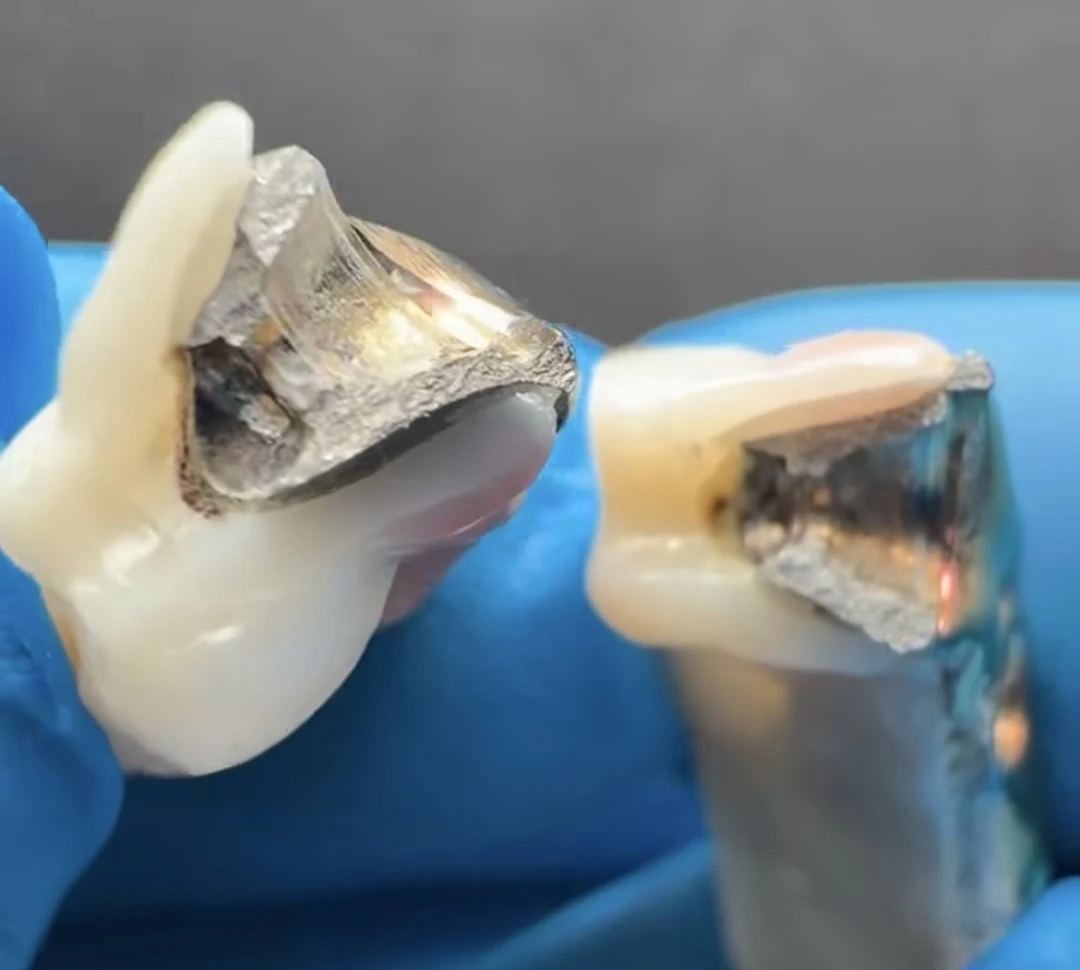
Titanium has high strength and does not break under a single chewing load, even a heavy one. The main cause of fracture in these bars is usually fatigue. That is, a force that on its own is not enough to break the bar, if repeated millions of times, creates a very small crack. This crack gradually grows. Eventually the remaining metal can no longer bear the force and the bar breaks. This is why a titanium bar may break after a long period of service without any unusual impact. Holes, milling scratches and sharp corners make it easier for these cracks to start.
4. The role of bruxism and implants in the opposing jaw
In bruxism, both the force and the number of loading cycles are higher. Both make metal fatigue progress faster. An implant prosthesis in the opposing jaw also matters. A natural tooth has a periodontal ligament. This ligament plays a role in transmitting force, and its sensory input helps control chewing force. An implant lacks this ligament and is less sensitive to pressure. When both jaws have implants, this sensory feedback is reduced on both sides. So heavier forces should be expected in these patients.
5. Other factors that may have played a role
If the bar does not have an adequate passive fit, a permanent stress is created in it when the screws are tightened. This stress adds to the chewing stress and shortens the life of the bar. Material and manufacturing method also matter. Milled grade 5 titanium, commercially pure titanium and printed titanium do not behave the same under fatigue. Occlusion matters too. Heavy contact on the cantilever, especially in lateral movements, directly raises the bending force. Until the part is examined directly, it is not possible to say how much each of these factors contributed in this case.
6. What should change in the new design?
In the new prosthesis our colleague has removed tooth 6 and thickened the connection area. Both decisions are sound. Shortening the cantilever shortens the lever arm and reduces the bending force on the last implant.
When thickening the bar, its direction matters. Increasing the height of the bar (from occlusal toward the tissue) raises its resistance far more than increasing its width. In a rectangular cross-section, if the height is doubled, the resistance to fracture (bending strength) increases about fourfold and the stiffness about eightfold. So, if space allows, it is better to increase the height of the bar in the region of the last implant. In addition, enough metal should remain around the screw channel and the corners should be rounded in the CAD design. In a bruxist patient, heavy contacts on the cantilever should be eliminated and a night guard should also be considered part of the treatment.
Clinical message
In a full-arch prosthesis, the strength of titanium alone does not guarantee the durability of the prosthesis. The length of the cantilever, the height of the bar in the region of the last implant and the amount of metal remaining around the screw channel also determine whether the prosthesis lasts over time.
This page is intended for educational use by dentists and dental students.