
Insight 60 — A Strategy for Managing VD and Jaw-Relation Uncertainty in Full-Arch Implant Patients
Published:
Last reviewed:
فارسی
Clinical Explanation
In full-arch implant reconstruction, because VD and relation error affects the anterior region more than the posterior, and anterior error — unlike posterior — can't be corrected by grinding, posterior abutments are fabricated from the start so the resin pattern can seat on them; anterior abutments are fabricated only after final VD confirmation
This note is about the stage that sits, in full-arch implant reconstruction, between the initial relation-and-VD record and the final prosthesis: the chairside resin-pattern try-in. When that try-in shows VD or the relation needs correcting, the real question is which abutments have already been fabricated at that point and which haven't. What follows: the geometric logic for why anterior and posterior error don't behave the same way, and an approach that, on that basis, fabricates posterior and anterior abutments in two separate stages.
-
The Problem
When I take a scan for a full-mouth or full-arch case, recording the relation and VD always carries some margin of error. The next stage, the lab fabricates a resin pattern, and occlusion and VD are checked chairside. The whole point of this stage is exactly that: catch a possible error before moving into the expensive stages.
The catch is that the resin pattern has to seat on something. If the lab fabricates the definitive abutment for every implant at this same stage, and the try-in shows that VD or the relation needs to change, some of those abutments become unusable. -
Why a Resin Abutment Didn't Work
A common workaround is having the lab make the abutments out of resin so the resin pattern has somewhere to seat. I had this done for me once, and it was so imprecise that having it made no difference either way. Evaluating VD needs a reproducible seat — not a component that's loose to begin with. -
The Geometric Logic: Why Anterior and Posterior Differ
Opening or closing VD means rotating the mandible around the hinge axis. Each point's linear displacement is directly proportional to its distance from that axis. The molar sits close to the axis, and the incisors are the farthest point on the arch. That's why a change in VD that shows up as one millimeter anteriorly is a fraction of a millimeter at the molar. Relation error itself isn't rotational, but because anterior abutments are angled, a change in relation matters more anteriorly than posteriorly.
One point needs to be stated precisely. When VD changes, the abutment itself doesn't move — it stays exactly where it is on its own implant. What changes is the position of the final teeth relative to the abutment, and that's exactly what puts an already-fabricated abutment out of commission. -
Why the Posterior Isn't a Problem in Practice
Posteriorly, the error is almost always vertical, not angular, and vertical error is manageable.
More importantly, I get VD roughly right from the very start. What needs correcting after the resin-pattern try-in is a small amount, not a full redefinition of the vertical dimension. Within that range, if we have to increase VD, the amount is never enough to leave a posterior abutment too short, and if we have to decrease it, that's manageable with adjustment and grinding too. That's why fabricating the definitive abutment for posterior implants before the try-in carries no meaningful risk. -
Why Anterior Error Isn't Correctable
Anterior abutments are both more angled to begin with, and the anterior tooth position shifts more with a change in VD. When overjet and overbite change, the path of insertion, the margin location, and the available thickness anteriorly all change with them. This is an angular error, and grinding can't rescue it. In other words, the exact region most likely to change is also the one with the least room to correct. -
What I Do
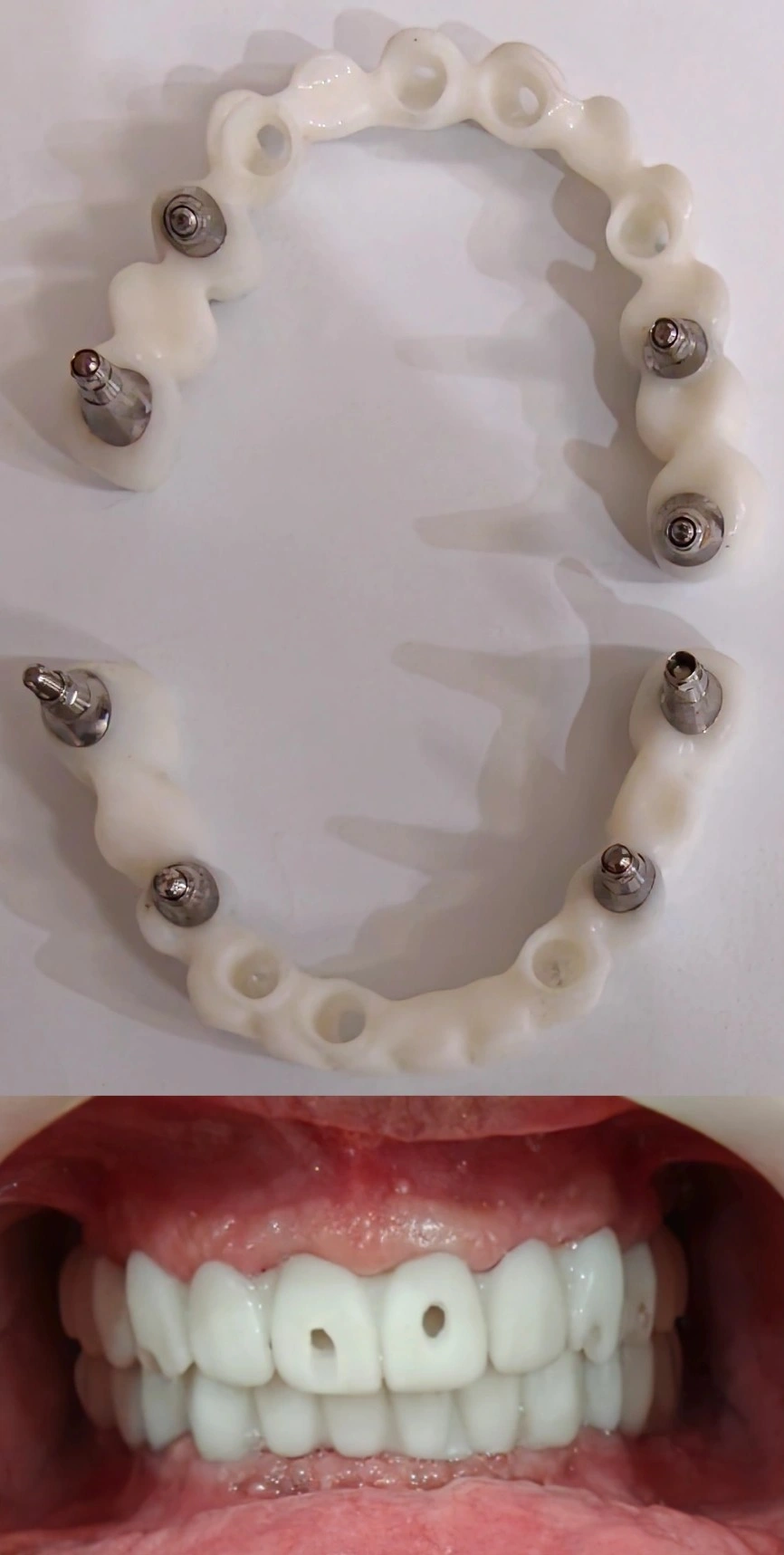
The lab fabricates definitive abutments for the posterior implants. The resin pattern's seat, retention, and stability all come from these. The anterior region stays without an abutment, and anterior abutments are fabricated only after VD and the relation are finally confirmed. -
In This Case
In the image, the resin pattern was built with the posterior abutments in place and the anterior region left empty, and it seated completely stable chairside. I checked the occlusion and tooth form and found no issue, but VD needed a slight increase. Because the anterior abutments hadn't been fabricated yet, that correction only cost a new record — not discarding fabricated abutments. -
The Bottom Line
In full-arch reconstruction, assuming the initial record is final is an expensive assumption. Separating the posterior abutments — as the seating base — from the anterior abutments — as the components that depend on the final VD — lets the resin-pattern stage do exactly the job it's designed for, without correcting it costing anything extra.
The content of this page is intended for the educational use of dentists and dental students.