
Insight 66 — The Importance of Dynamic Clearance When Building an Anterior Core
Published:
Last reviewed:
فارسی
Clinical Explanation
When building an anterior post and core, clearance has to be judged along the entire path of lateral and protrusive movement, not at a single static point — otherwise the space for the crown's thickness does not survive the excursion, but in deep bite cases the problem is more acute
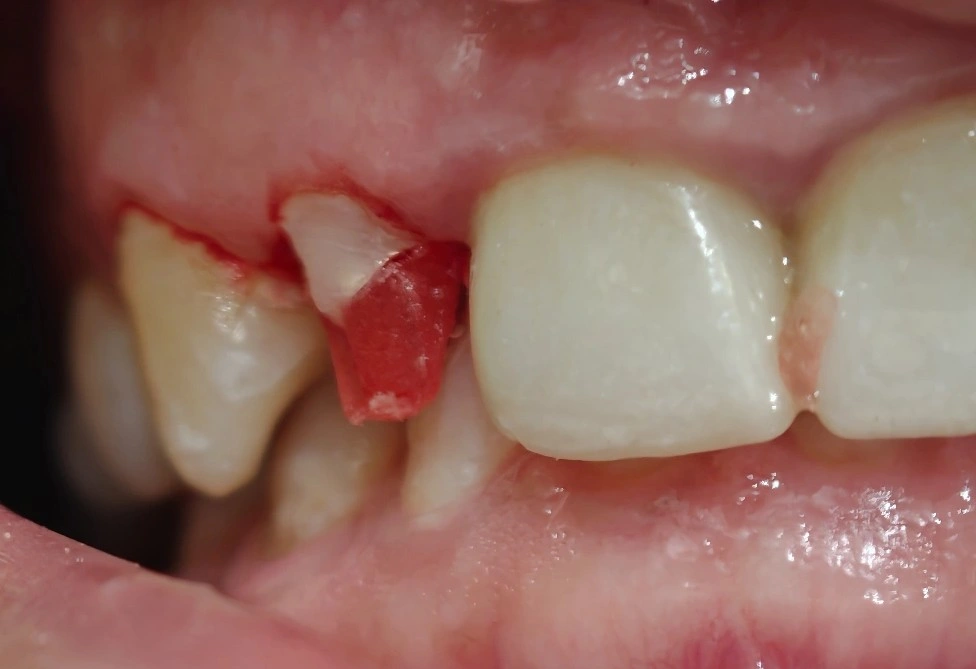
This note is about something that is easy to miss at the core-building stage in the anterior region: space that looks sufficient chairside at one fixed point does not necessarily remain along the path of jaw movement. In the deep bite case in this image, that very difference showed up in lateral movement, and the form of the core had to be corrected.
-
Clinical Explanation
When building a post and core for anterior teeth, there is a very important clinical point: clearance must not be checked in the static position alone. It is not only about relieving interference at one fixed point; the space we allow for the thickness of the final crown material has to be preserved to the same extent along the whole path of lateral and protrusive movement. -
Clinical Consequences of Missing Clearance in Excursions
If that space is not checked in excursions, we run into a serious problem at the try-in and delivery appointment: either the crown binds along the path of movement and transmits destructive forces to the system, or, to relieve that interference, we are forced to grind so much off the palatal surface of the crown chairside that the material becomes severely thin, loses its strength, and may even perforate. -
The Challenge in Deep Bite Cases
This matters far more when the patient has a deep bite — exactly like the case shown in the image. The patient has a deep bite, and the acrylic core I had built struck the opposing tooth completely in lateral movement, leaving no space at all for the crown's thickness along the path of movement. -
Managing and Correcting the Form of the Core
What I did to solve the problem in this case was this: to open the path of movement for the opposing tooth, I reduced the palatal surface of the core. But so that the support of the core would not be diminished or thinned, I compensated for that loss of volume by adding acrylic to the buccal surface. Finally, I re-marked and rechecked the jaw movements to make sure there was no interference left and that a safe clearance had been fully established along the whole path of movement.
The content of this page is intended for the educational use of dentists and dental students.