
Veneer-Retained Bridges: When Are They a Suitable Choice?
Introduction
Suppose a patient has lost an anterior tooth, while the adjacent teeth are sound. An implant is one option, but limited space or bone, root proximity, or unwillingness to undergo surgery may make this choice difficult. A conventional bridge also requires substantial preparation of the adjacent teeth.
A resin-bonded bridge with lingual or palatal retainers is a more conservative option, but it has limitations in some circumstances; for example, a deep bite may restrict the space available for a palatal retainer. Such a retainer also does not correct the shape or color of the adjacent teeth.
The idea of a veneer-retained fixed dental prosthesis (VRFDP) is to connect the pontic to veneers on the adjacent teeth. In a suitable case, tooth replacement and correction of the abutment teeth's shape can therefore be achieved in a single treatment.
A paper published in 2025 reported this approach in three patients with a total of four bridges, because the first patient had two missing teeth. Follow-up extended up to five years.
Explanation
When should we consider a veneer-retained bridge?
This approach is not intended to replace every resin-bonded bridge. Its rationale is stronger when the adjacent teeth already require veneers, when management of the edentulous space also requires changes to tooth shape, or when occlusion makes lingual or palatal retainers difficult to use.
The paper's three cases illustrate three different situations.
Case 1: deep bite and limitations of lingual retainers
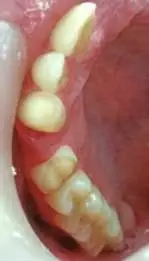
A 22-year-old patient was missing the left maxillary and mandibular first premolars. The adjacent teeth were vital and unrestored, but the patient had a severe deep bite and steep anterior guidance. Following previous orthodontic treatment, the roots adjacent to the edentulous spaces were also tipped, and the patient declined further orthodontic treatment.
Because of the deep bite, the authors considered conventional resin-bonded retainers unsuitable and selected veneer-retained bridges made from monolithic lithium disilicate for both sites. An onlay design was used for the maxillary premolar abutment because of the direction of occlusal forces.
Clinical point: When a lingual or palatal retainer is incompatible with the occlusion, another design may be considered, provided sufficient space is available for the restorative material and connectors.
Case 2: combining tooth replacement with space management
A 45-year-old patient lost the mandibular right lateral incisor because of severe periodontal disease. The patient had a 3-mm anterior open bite, spacing between the anterior teeth, and mild discoloration. After extraction, the crown of the same tooth was used as a provisional pontic for two months.
The available space was wider than the natural dimensions of a mandibular lateral incisor. A bridge with a lingual retainer, without correcting tooth shape and redistributing the space, could therefore have produced an unsatisfactory esthetic result. A veneer-retained bridge was consequently designed for the right lateral incisor, with separate veneers for the anterior teeth on the left.
Clinical point: Sometimes the problem involves more than filling a gap; the width and shape of the adjacent teeth must also be considered in the treatment plan.
Case 3: when the abutment teeth themselves need veneers
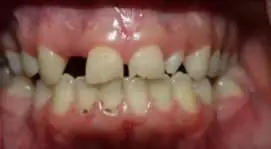
A 21-year-old patient was missing the maxillary right lateral incisor. The left lateral incisor was peg-shaped, a diastema was present between the central incisors, and the central incisal edges were worn. The patient was unwilling to undergo implant surgery, and improving the anterior esthetics was also part of treatment.
If a palatally retained resin-bonded bridge had been combined with labial veneers, some abutment teeth would have required preparation on both labial and palatal surfaces. The authors therefore decided that the same labial veneers would also act as bridge retainers.
Clinical point: When veneers are already indicated for the abutment teeth, additional palatal preparation for separate retainers can be avoided. If the abutment teeth are completely sound, however, labial preparation solely to support a bridge is not necessarily more conservative.
Retainer design: why do connectors matter?
Lithium disilicate was used in this report. The veneer retainers were described as having a butt-joint design with approximately 2 mm of incisal preparation and 0.5–1 mm of labial preparation. Only limited incisal modification was performed in case 2. On the side facing the edentulous space, preparation extended to the proximolingual line angle to provide sufficient connector width.
Because the pontic is supported through connections to relatively thin retainers, connector dimensions are important. The authors refer to the manufacturer's recommendation for a 16-mm² cross-sectional area and, when buccolingual width is limited, increasing the connector's occlusogingival height. A height-to-width ratio greater than one is also discussed.
These dimensions relate to the material protocol and design under discussion; they should not be generalized to all bridges without checking the indication and the manufacturer's instructions.
Occlusion: part of planning, not just delivery
A wax-up and mock-up were used to assess form and occlusion before fabrication. Canine guidance was planned in cases 1 and 3. In case 2, occlusal correction was not planned because the patient did not wish to change the existing open bite.
The aim was to adjust centric and eccentric contacts so that excessive stress was not applied to the pontic. Conservative preparation alone does not guarantee bridge success; connector design and force control are also decisive.
Treatment outcomes and earlier evidence
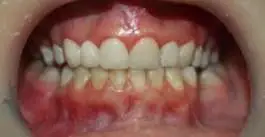
The authors reported annual follow-up for up to five years, with no mechanical or biological complications. Patients were satisfied with the treatment results.
This is encouraging, but it should not be interpreted as a five-year success rate for this approach; the paper describes only three patients and does not specify the follow-up duration of each bridge separately.
The literature review included seven previous reports. Some older reports, particularly those using feldspathic porcelain, described pontic or retainer fractures, marginal problems, and periodontal complications. Lithium disilicate may offer an advantage in the present report, but these uncontrolled reports cannot establish the independent effect of ceramic material.
Conclusion
A veneer-retained bridge is an option for selected cases, rather than a general replacement for implants or conventional resin-bonded bridges.
This design becomes more attractive when tooth replacement is combined with correction of the adjacent teeth's shape, color, or space distribution, or when occlusion limits the use of lingual and palatal retainers.
My clinical interpretation of the paper is that the main question is more than "How do we replace the missing tooth?" We should consider which design can provide the required esthetics and mechanical strength with the minimum justifiable tooth preparation. Further controlled studies may help evaluate the clinical parameters of this treatment, such as the optimum preparation design.