
Do Full-Arch Prostheses Really Need a Titanium Bar?
A titanium bar is commonly used when fabricating an implant-supported fixed full-arch prosthesis. But is the bar actually necessary? Could the prosthesis instead be fabricated entirely from monolithic zirconia?
The 2021 systematic review by Delucchi and colleagues found that titanium, metal-alloy, and zirconia frameworks can all deliver acceptable clinical outcomes. Implant and prosthesis survival exceeded 90% in most studies, and most comparisons found no statistically significant differences between materials.
However, that review did not directly answer an important question: if a full-arch prosthesis is to be fabricated from monolithic zirconia, what benefit does adding a titanium bar provide?
An in vitro study by Sasany and colleagues, published in The Journal of Prosthetic Dentistry in 2026, addressed precisely this question.
How does a titanium bar affect prosthesis strength?
The researchers compared 30 maxillary full-arch prostheses on models containing six implants, divided into three groups:
- Conventional Katana zirconia with a titanium bar
- The same Katana zirconia without a metal bar
- High-strength Ice Plus zirconia without a metal bar
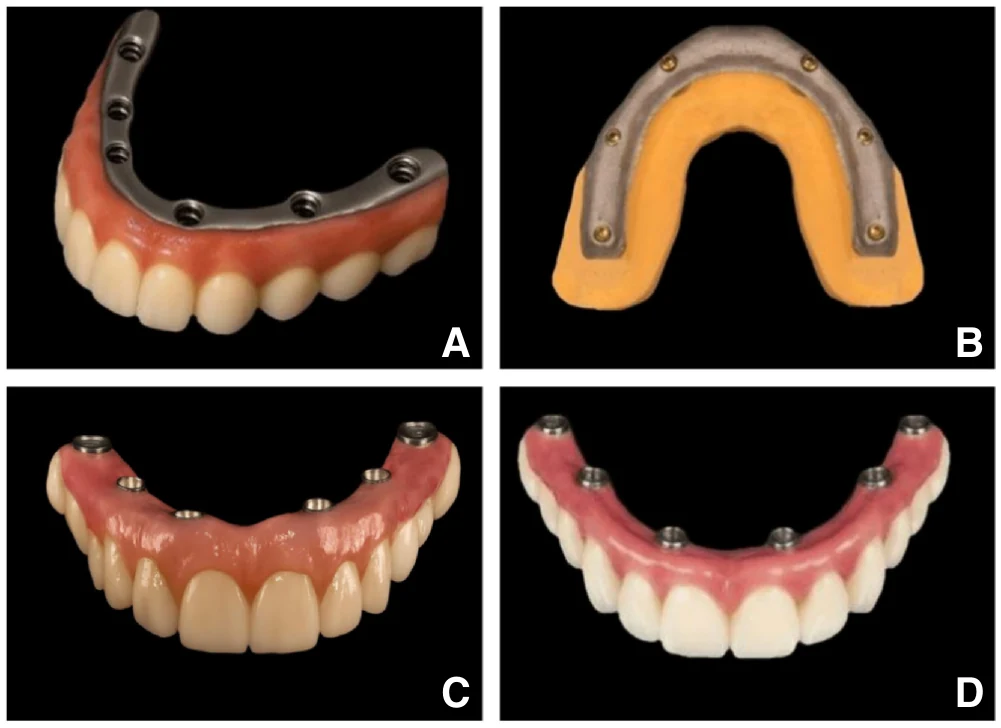
After simulated mastication and thermocycling, the prostheses were tested for fracture resistance.
Fracture resistance results:
| Prosthesis | Mean fracture load |
|---|---|
| Katana without a bar | 900 N |
| Katana with a titanium bar | 1550 N |
| Ice Plus without a bar | 1700 N |
The differences between all three groups were statistically significant.
Adding a titanium bar substantially increased the fracture resistance of conventional Katana zirconia. Meanwhile, high-strength Ice Plus zirconia without a metal bar showed greater fracture resistance than titanium-reinforced Katana.
The type of zirconia and its mechanical properties may therefore be as important as the presence of a bar, or even more important.
These findings should not be interpreted as showing that removing a bar itself increases strength: the study included no Ice Plus group with a bar, and two different zirconia materials were compared.
Is greater strength always clinically important?
This part of the paper's discussion is particularly relevant.
Citing earlier studies, the authors describe reported maximum bite forces of approximately 500 to 900 N.
Both Katana with a bar and Ice Plus without a bar therefore had fracture resistance above this range.
But an important question remains: when a prosthesis withstands 1550 N in a laboratory test, does increasing that value to 1700 N have meaningful clinical implications?
The paper does not demonstrate that this 150 N difference improves clinical survival or reduces complications. The authors only suggest that the greater strength of Ice Plus may provide additional protection against fracture in patients with parafunctional habits.
Furthermore, the fracture load measured in a final load-to-failure test is not equivalent to long-term intraoral performance. This study used only short-term aging and did not simulate patient-specific occlusion or parafunction.
Thus, 900 N should not be treated as a definitive threshold for clinical success, just as a higher fracture load does not necessarily mean greater clinical durability.
Is every monolithic zirconia suitable for a bar-free design?
Both zirconia materials used in the study were 3Y-TZP, but their processing differed.
Ice Plus zirconia was produced using hot isostatic pressing (HIP). By increasing density, reducing porosity, and refining the grain structure, this process can improve mechanical strength.
The manufacturers' stated flexural strengths were approximately 1200 MPa for Katana and 1900 MPa for Ice Plus.
This distinction is particularly relevant to contemporary multilayer zirconias.
The term multilayer does not necessarily identify a specific composition. Depending on the product, it may involve 3Y, 4Y, and 5Y compositions or layers with different properties.
Consequently, these findings cannot be directly generalized to every multilayer zirconia, particularly when the composition has been altered to increase translucency.
When selecting zirconia for a bar-free design, the labels monolithic and multilayer are insufficient: the composition, mechanical properties, and design limitations of the specific block must be known.
Does a titanium bar offer any other advantages?
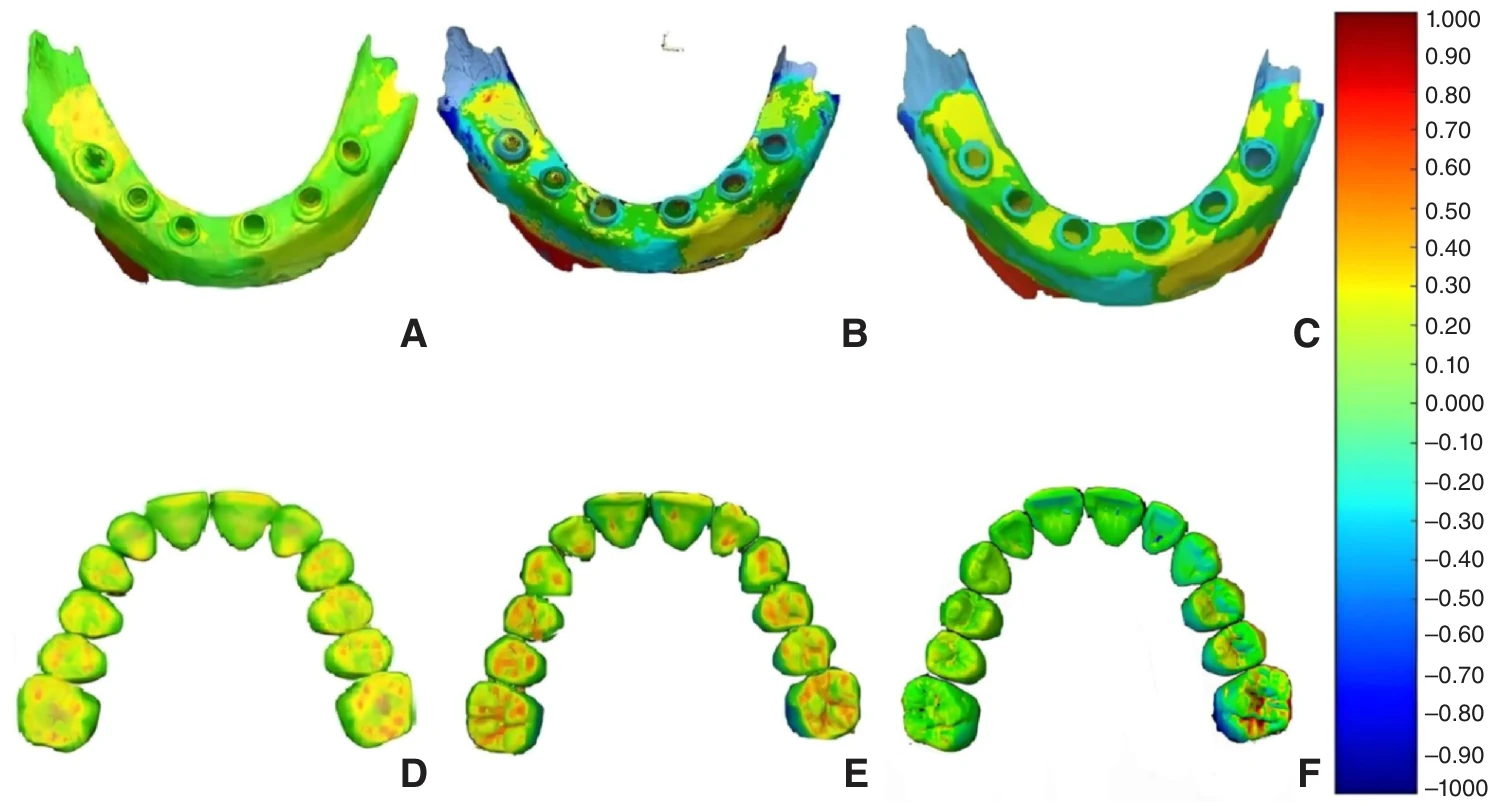
In the 2026 study, the titanium-bar group showed better marginal trueness as well as greater strength than Katana without a bar. The authors suggest that the bar may have acted as a stabilizer during bonding.
Mean marginal deviation was approximately 38 μm in the bar group, compared with approximately 45 to 46 μm in the two bar-free groups.
However, the authors note that all these values were well below the approximately 120 μm range previously proposed as clinically acceptable.
According to the authors, the observed difference in marginal trueness is therefore unlikely to have substantial clinical significance despite being statistically significant.
By contrast, Ice Plus without a bar performed best in overall agreement with the digital design.
Thermocycling revealed another difference. Conventional Katana zirconia showed a significant increase in tetragonal-to-monoclinic phase transformation, both with and without a bar, whereas Ice Plus showed no significant change.
From a design perspective, eliminating the titanium bar may simplify fabrication, reduce prosthesis bulk, and remove the bar-to-zirconia adhesive interface, which can itself be a site of bond failure.
A titanium bar, in turn, can reinforce a conventional zirconia structure.
What about other framework materials?
The 2021 systematic review found that cast metal alloys, such as gold and silver-palladium, remain reliable options because of their long track record and favorable clinical performance.
A one-piece milled titanium framework also performed similarly to a cast gold framework in a ten-year study.
Carbon-fiber-reinforced composites have shown promising early results, but their long-term evidence remains limited.
By comparison, PMMA and acrylic resin without metal reinforcement have lower stiffness and require greater thickness to achieve sufficient rigidity.
Although several framework options are available, they cannot be regarded as fully equivalent in mechanical properties or clinical evidence.
Clinical conclusion: should a bar be used?
Taken together, these two papers suggest that a titanium bar is not mandatory for every fixed full-arch prosthesis.
Zirconia frameworks have delivered acceptable short- and medium-term clinical outcomes, and some high-strength zirconias have shown favorable laboratory fracture resistance even without a metal bar.
The 2026 study also showed that although a titanium bar increases the strength of conventional zirconia, high-strength zirconia without a bar can withstand loads above reported bite forces.
This does not mean that titanium bars should be eliminated in every situation.
Ultimately, the number and distribution of implants, cantilever length, available prosthetic space, material thickness, occlusal forces, parafunction, and zirconia type must all be considered.
The 2026 study was an in vitro investigation and did not assess long-term clinical survival. It therefore cannot establish that high-strength zirconia without a bar is superior to a titanium-bar prosthesis in every situation.
The final message of these two papers is that a titanium bar is a means of reinforcement rather than a mandatory component of every full-arch prosthesis. The goal is not simply to obtain the highest possible fracture load, but to achieve sufficient strength and durability under actual functional conditions.